Eight forms that stop a service job turning into an argument
You take in an AC with a remote, a phone with a scratched screen, a sofa with a torn cushion — and three weeks later the customer says the remote was never there, or that they never agreed to ₹2,400. Not because they are lying, but because nothing was written down. This kit is the paperwork for that: a job card that records what came in and in what condition, an estimate with a number the customer signs, a work order for the technician, a delivery challan for goods moving out, an AMC contract, a warranty certificate, a handover note and a payment receipt. Each one is a single A4 page, supplied as an unlocked Word file you can brand in a minute and a print-ready PDF for the pad on the counter.
Get the Kit — ₹249 →Almost every service-business argument is about a fact nobody wrote down
The most common handover dispute in appliance repair. A ticked accessory list, read back to the customer at intake, settles it in one line.
An estimate signed before work begins — or marked "approved on call, 4:20 pm" — is the difference between a paid invoice and a discount you did not plan.
A condition note and four photographs at intake, recorded on the same page the customer signs, protects you from damage you did not cause.
A warranty certificate that separates your workmanship warranty from the manufacturer's part warranty makes the answer obvious instead of negotiable.
Equipment listed, visits counted, exclusions ticked, response time stated. An AMC that says what is excluded is the only kind that survives a bad month.
A receipt with the mode, the UTR and the balance due is the record that outlives a WhatsApp chat and a changed phone.
Any business that collects an item, visits a site, or fits something that can fail
Job card at intake, estimate before gas filling or a board change, warranty on the work, receipt at handover. The daily-use set.
Site visit, work order to the team, delivery challan for material, handover note with balance payment and a workmanship warranty.
Challan for goods moving in and out on job work, with HSN, quantity and an e-way bill reference where one applies.
An estimate the customer signs, a work order for the technician, and an AMC for the annual customers who pay you every quarter.
Each is a complete A4 form with its own terms — not a blank grid
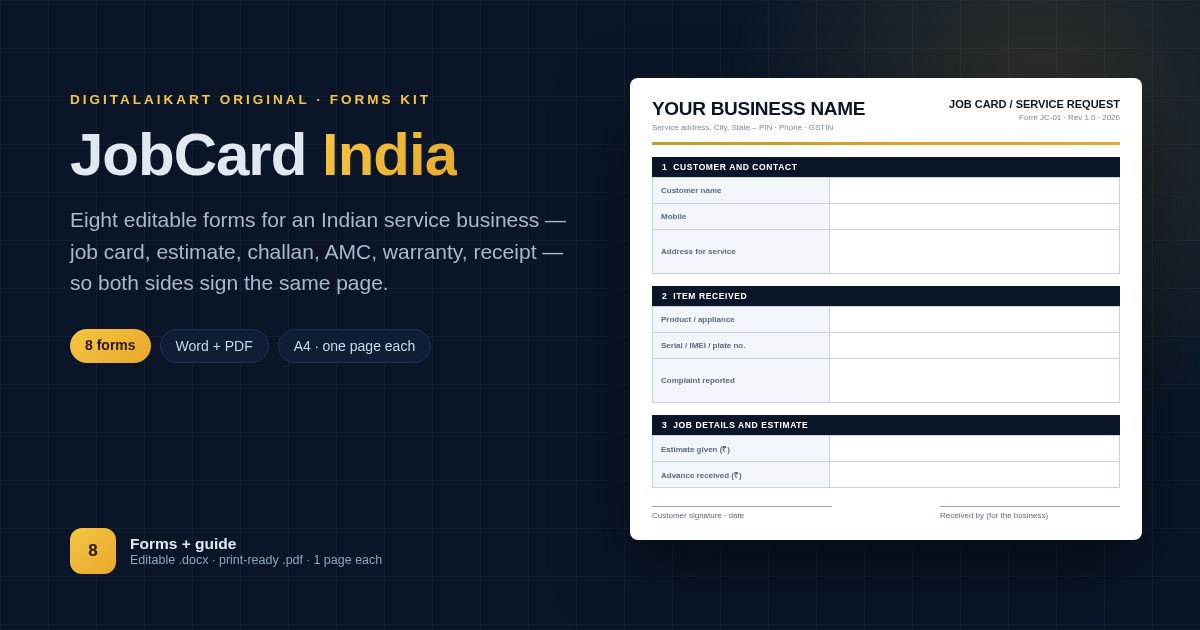
Customer and contact, item received with brand, model and serial, the complaint in the customer's own words, an accessory checklist (power cable, remote, battery, memory card, cover, manual, mounting kit), condition at intake, estimate given, advance taken, technician assigned, and five terms covering data, storage charges and the workmanship warranty.
Seven line rows with HSN or SAC, quantity, rate and amount; sub-total, discount, CGST and SGST, round-off and total; advance required; a validity date; an "excluded unless written above" checklist; and a clause capping variation at 10 per cent without fresh approval.
What the technician is sent to do, parts issued with serial numbers, a pre-work safety checklist, completion details, and signatures from both the technician and the customer at the site.
Consignee, challan number, goods with HSN, quantity and serial numbers, reason for movement (repair return, job work, replacement, sale, approval), e-way bill reference, packages, declared value, and a remarks box for shortage or damage at delivery.
Equipment covered, preventive visits, response time, working hours, what is included and chargeable, an eight-point exclusion checklist, annual fee with GST, escalation, termination on 30 days' notice and jurisdiction.
What is covered and for how long, what the warranty promises in plain words, an eight-point "what voids this" checklist, and a claim process with the numbers to call.
Work carried out, parts replaced with their warranty, an eight-point test checklist, billing, advance adjusted, balance received with mode and UTR, a customer remarks box and acceptance.
Received from, against which job or invoice, amount in figures and words, mode (UPI, cash, card, NEFT, cheque), UTR or cheque number, total job value, balance due, next instalment with a due date, and notes.
Not a legal-document set written for a law firm
Underscores where you write, tick boxes where you choose, and boxes tall enough for a real address in a real handwriting. Nothing needs a laptop at the counter.
Every form fits a single page at 100 per cent scale, so a duplicate pad gives you an office copy and a customer copy from one writing.
HSN and SAC columns, CGST and SGST rows, place of supply, GSTIN fields and an e-way bill reference — on the estimate and the challan, not bolted onto every page.
₹ amounts, UPI and UTR, AWB and courier language, COD-style cash collection, AMC culture, and the storage-charge clause every Indian workshop needs.
Change the name, the logo, the storage charge, the warranty period, or a whole clause. The formatting holds because it is built from tables, not text boxes.
Ten sections: which form for which moment, a numbering scheme, what to capture at intake, why each clause is there, GST and e-way bill notes, printing and tablet tips, and troubleshooting.
One ZIP, 21 files, nothing else to buy
Eight forms, each as an editable .docx and a print-ready .pdf. Named 01-job-card through 08-payment-receipt so the folder sorts in the order you use them.
Which form for which moment, the numbering scheme, the five-minute intake habit, the seven clauses that do the real work, GST and e-way bill notes, printing and digital-fill instructions, and a troubleshooting table.
For the folder that gets passed to a manager or a counter assistant.
Use in your own business, unlimited printing, unlimited edits. No resale or redistribution of the files.
Brand the set once, print a pad, use it every day
Unzip the folder anywhere. There is nothing to install and no software to buy.
Open 01-job-card.docx, replace "YOUR BUSINESS NAME" and the grey address line, and use Find & Replace on the other seven. About ten minutes in total.
Print a pad on A4 at 100 per cent, or open the PDF on a tablet and write with a stylus, then send the flattened PDF to the customer.
Job card at intake, estimate before work, work order to the technician, handover note at completion, receipt when money changes hands. The guide maps every step.
What a printed form actually looks like
Customer and contact, item received, job details and estimate — each numbered, so you can point a customer to the line you are talking about.
Grey label cells with the field name, white cells to write in. Readable at a glance across a counter, and legible after a photocopy.
Five numbered clauses on the job card, six on the AMC, four on the receipt — printed where the customer signs, not on a separate sheet they never read.
The cover image above is a render of the job card from the kit, not a mock-up.
Files you can open anywhere, on any computer in the shop
Eight .docx (Office Open XML) and eight .pdf, plus the guide, README and licence. About 530 KB in total. Unzips on Windows, macOS, Linux and Android.
Word 2016 and later, Microsoft 365, LibreOffice Writer, Google Docs, WPS Office and Pages. The PDFs open in any browser or PDF reader, including on a phone.
Nothing beyond a word processor for editing, and a printer or a PDF reader for using. No fonts to install — Calibri ships with Word and is substituted by the metric-compatible Carlito in LibreOffice.
One-time payment · Lifetime access · No subscription
Yes. Every form is an unlocked .docx that opens in Word 2016 or later, Microsoft 365, LibreOffice, Google Docs, WPS Office and Pages. Change the business name, the logo, a clause, or the storage charge — the layout is built from tables, so it holds when you type.
A form signed by both sides is useful evidence of what was agreed, and that is the point of the kit. The wording is a sensible starting point for an Indian service business — it is not legal advice, and it is not a substitute for your own lawyer's review if a dispute is likely to be significant. The guide says the same thing.
No. A challan documents the movement of goods; a tax invoice documents a supply and charges GST. The challan in this kit states that on the form, and carries HSN, serial numbers and an e-way bill reference. If you need a GST invoice with line items and a UPI payment block, this kit is not that product — the estimate covers the quotation side, not the final tax invoice.
Yes. Unlimited printing in your own business, for as long as you like. Duplicate or carbonless pads work well for job cards and receipts: one writing gives you an office copy and a customer copy.
Yes. Leave the GSTIN field blank, put a dash in the CGST and SGST rows on the estimate, and the rest of the form is unaffected. The guide explains which fields to skip.
Yes. Open the PDF in Adobe Acrobat, Xodo or Samsung Notes, write with a stylus, then export a flattened PDF and send it to the customer on WhatsApp. Keep the flattened copy against the job number.
No. One-time ₹249. No monthly fee, no per-print charge, no watermark, and no limit on how many jobs you use the forms for.
After a successful payment on Razorpay you land on a thank-you page with a download button. Click it for the ZIP and save it — there is no account or dashboard to log back into.
Digital products are non-refundable because they are instantly downloadable. But if you receive a corrupted file or a form will not open, we will fix or replace it — email lonefaisal977@gmail.com within 7 days.
Other Digitalaikart originals for a small service business
An offline invoicing tool for India — the tax invoice that follows the challan and the estimate in this kit.
An offline credit ledger and payment reminder app, for the customers whose balance sits open for weeks.
A staff shift and leave roster planner — useful once you have technicians to schedule against the work orders.
Eight forms · Editable Word + print-ready PDF · A4, one page each · Guide and licence included · One-time ₹249.
Get the Kit →