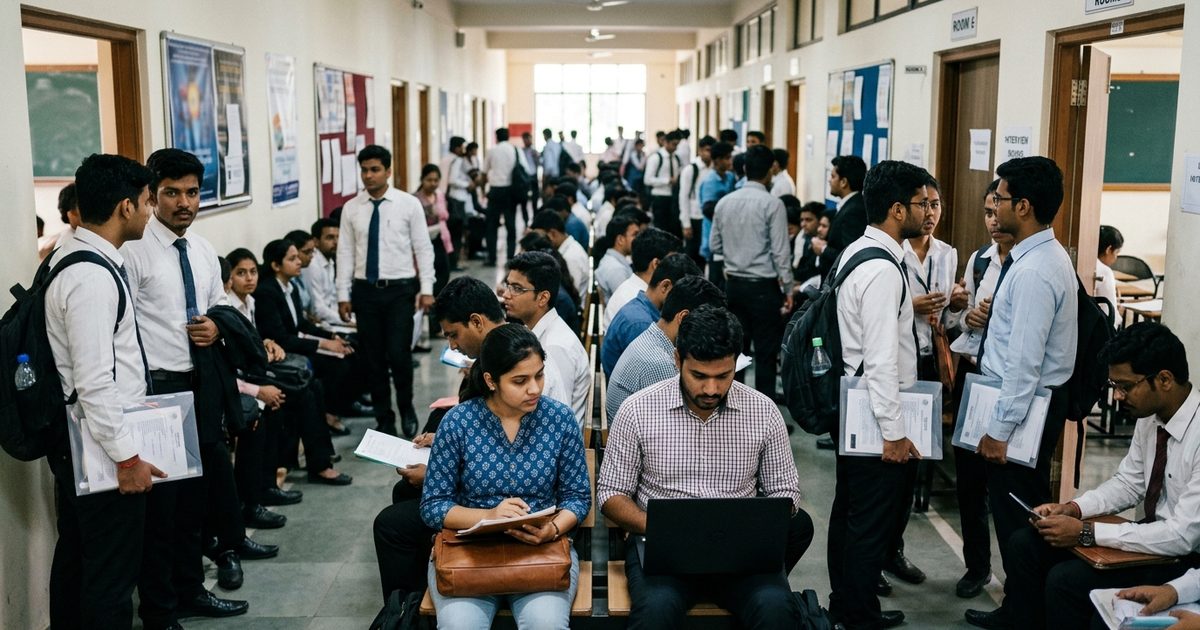
01.The placement season starts on 1 December
The final placement season at the seven older Indian Institutes of Technology, Kharagpur, Bombay, Madras, Kanpur, Delhi, Guwahati and Roorkee, is scheduled to begin on 1 December 2026. As it approaches, recruiters are turning to these campuses to hire for artificial intelligence and related roles, with pre-placement offers and demand for specialised skills shaping their plans. Companies are looking beyond conventional software and engineering roles to candidates with expertise in AI, data science and analytics.
That demand does not automatically mean a broad recovery in fresher hiring. Some employers remain cautious about expanding entry-level headcount even as they hunt for specialised AI talent. In other words, the door is opening wider for students who can show AI skills, while staying narrow for generalist software roles. The overall picture is of a market that is being reshaped rather than simply expanded.
02.New roles and new courses on campus
At IIT Guwahati, new opportunities are emerging in applied AI and AI-assisted technology even as traditional software and services hiring faces pressure, according to the head of the institute's Centre for Career Development. AI-focused companies, banks and financial services firms, and quantitative trading firms are expected to be among the recruiters at IIT Kanpur.
Campuses have been adjusting their offerings to match. IIT Kharagpur expects hiring across technology and software, AI and data, finance, semiconductors and core engineering, and has expanded its academic offerings to include a four-year BTech programme in AI, alongside programmes and micro-specialisations in AI and machine learning. Officials at IIT Guwahati noted that roles which were not available during the previous placement cycle are now emerging, and that students with stronger AI skills could have an advantage in the recruitment process. Internships continue to matter, because they let companies assess candidates before extending pre-placement offers, particularly in information technology and data science. Startups are also expected to add to campus hiring, with young firms in technology, AI, fintech and deep tech showing interest.
03.A gap between what workers want and what employers give
The appetite for AI skills is not limited to students. A new report by Talent500, part of ANSR, surveyed 2,000 technology, product and data professionals across India and found that 71% consider hands-on AI upskilling important, but only 29% said their current employers provide it. That is a wide gap between what people expect from a job and what they are actually offered.
The same report found that career clarity now drives decisions. As many as 87% said defined career-growth information was very important when assessing an organisation, and 79% said they would abandon an application or decline an offer if a clear career path was missing. Nearly 59% said they were actively looking for their next role, and global capability centres emerged as the preferred destination for the next move, chosen by 69% of respondents.
04.India's AI talent pool is growing, mostly on its own
Confidence is high. Deloitte's Global Gen Z and Millennial Survey, released in May 2026, found that 85% of Indian Gen Z respondents and 91% of millennials feel confident applying AI in their work, and that 93% to 95% use AI tools regularly on the job. Much of that skill, however, is self-built: only about 32% of Gen Z respondents and 35% of millennials had completed any formal AI training.
The pipeline is expanding. Deloitte and NASSCOM project that India's AI talent pool will grow from roughly 600,000 to more than 1.25 million professionals by 2027, even as the AI market itself grows at an estimated 25% to 35% a year. Supply is rising, but demand is rising faster, which is why structured training, and not just individual enthusiasm, is being called for.
05.What it means for students and professionals
For students, the message from this placement season is to show applied AI work rather than a passing familiarity with tools. A project that uses AI to solve a real problem, an internship where you built something, or coursework in machine learning and data will stand out more than a single line on a resume. Starting early on internships matters, because they remain the most reliable route to a pre-placement offer.
For working professionals, the survey numbers point to a practical move: ask for hands-on AI projects rather than only training modules, and be clear about the career path you want. Employers that cannot show either will find it harder to hold on to talent. The findings also suggest that formal training still lags behind day-to-day use, so professionals who can point to real AI work, and to the judgement to check its output, are likely to have an edge in interviews. For small businesses and teams, the same logic runs in reverse, since the people who can use AI well are becoming the ones worth hiring and keeping.
Frequently asked questions
When does the IIT final placement season begin?
The final placement season at the seven older IITs, Kharagpur, Bombay, Madras, Kanpur, Delhi, Guwahati and Roorkee, is scheduled to begin on 1 December 2026.
Which skills are recruiters looking for this year?
Recruiters are looking beyond conventional software and engineering roles to candidates with AI, data science and analytics expertise, along with applied AI and AI-assisted technology skills.
What does the Talent500 report say about AI upskilling?
It found that 71% of surveyed tech, product and data professionals consider hands-on AI upskilling important, but only 29% said their employers provide it.