01.A Government Push for AI in Space Exploration
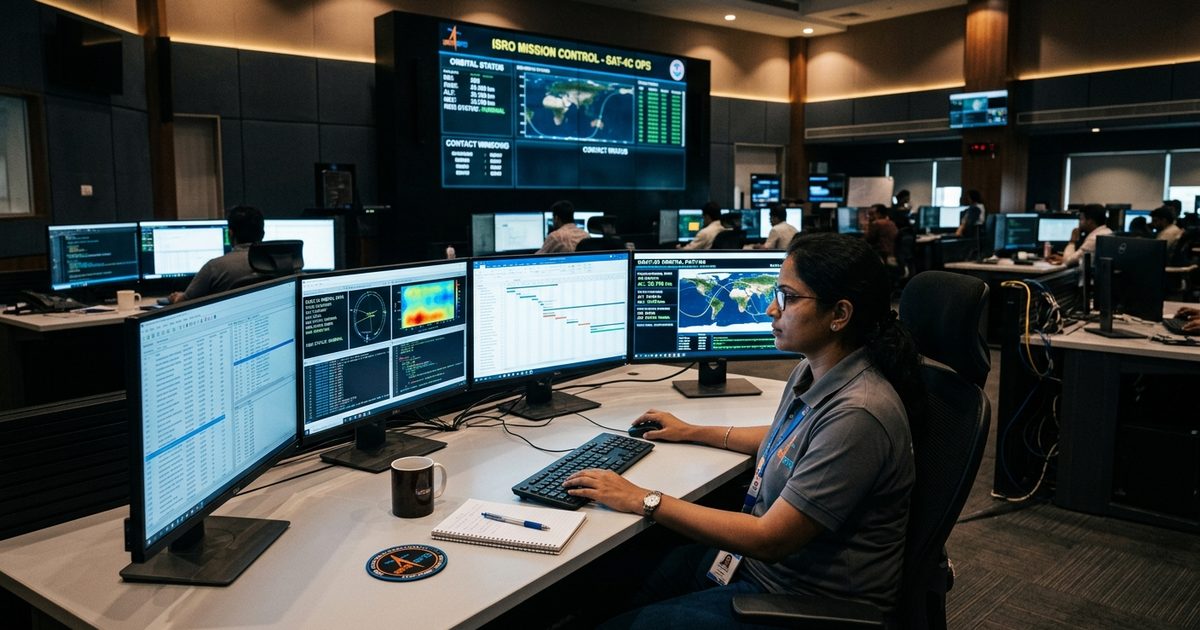
In a notable public statement covered by Bloomberg, a minister announced that artificial intelligence will empower India's space missions. The remarks place automated intelligence and advanced computational models at the heart of the country's upcoming aerospace initiatives. Rather than treating artificial intelligence merely as an administrative or auxiliary software tool, the government is highlighting its role as a fundamental driver for deep-space science, satellite operations, and high-stakes exploration.
The statement arrives at a moment when space programs worldwide are navigating increasingly intricate mission profiles. As spacecraft venture further and gather unprecedented volumes of data, relying purely on manual command structures and ground control becomes impractical. By leaning into artificial intelligence, the country aims to reinforce its technological capabilities and ensure its aerospace programs operate at the frontier of international benchmarks.
02.How AI Enhances Complex Space Operations
Artificial intelligence plays an increasingly practical role in modern aerospace. Space operations generate massive volumes of sensor telemetry, optical feeds, and environmental metrics that need to be processed without latency. Machine learning models can comb through thousands of data streams in real time, detecting anomalies, predicting hardware degradation before failures occur, and offering automated recommendations to flight controllers on the ground.
Beyond ground support, autonomous onboard computing allows spacecraft and orbital probes to make critical adjustments when communication latency delays human input. Automated visual navigation, intelligent landing hazard detection, and fuel-efficient trajectory corrections all rely heavily on algorithms capable of making swift decisions in uncertain orbital environments. The minister's focus underscores that developing and adopting these specialized systems is crucial for the success of future missions.
03.Opportunities for Indian Engineers and Researchers
For India's expanding pool of software developers, data scientists, and robotics engineers, this policy focus highlights clear career pathways. Aerospace-grade software requires robust error tolerance, edge-computing efficiency, and high-reliability programming that differs significantly from conventional consumer applications. As national space initiatives prioritize machine intelligence, academic laboratories and research centers will have stronger incentives to bridge computer science with aerospace engineering.
Students and technical professionals looking to contribute to the field will find growing value in mastering specialized machine learning domains. Areas such as computer vision for planetary surface mapping, autonomous path planning, and real-time sensor fusion are becoming core technical requirements. The explicit governmental backing for intelligent space systems suggests sustained long-term relevance for specialized engineering talent across both public institutes and associated research facilities.
04.Catalyzing India's Deep-Tech and Aerospace Startups
The domestic commercial space sector stands to gain considerable momentum from the emphasis on intelligent systems. Private aerospace ventures and deep-tech enterprises frequently develop specialized software architectures, lightweight algorithms, and remote-sensing analytical platforms that feed into broader national programs. A national environment that views artificial intelligence as an essential mission enabler provides startup founders with a clear direction for research and development.
By aligning commercial research with national space priorities, private enterprises can build high-value solutions ranging from automated satellite payload management to automated earth-observation data interpretation. This synergy between government ambition and entrepreneurial innovation can create a self-sustaining ecosystem, reducing reliance on foreign software stacks and strengthening domestic technological independence.
05.The Path Toward Intelligent Space Exploration
As India expands its vision for space exploration, the operational challenges will naturally grow more complex. Extended missions require long operational lifespans, extreme precision, and the capacity to handle unexpected environmental hurdles without direct intervention. The minister's validation of artificial intelligence confirms that future missions will increasingly depend on software autonomy alongside structural and propulsion engineering.
Integrating intelligence into aerospace operations demonstrates a broader commitment to leading in foundational frontier technologies. For observers across the Indian tech ecosystem, the direction is definitive: the future of national space exploration will be shaped as much by smart algorithms and computational power as by heavy launch vehicles and physical hardware.
Frequently asked questions
What did the minister state regarding AI and space missions?
The minister highlighted that artificial intelligence will empower India's space missions, emphasizing its growing role in driving national aerospace programs.
Why is artificial intelligence needed in space exploration?
AI enables autonomous spacecraft navigation, accelerates real-time telemetry analysis, and automates anomaly detection when ground communication is delayed.
How does this emphasis affect the Indian tech industry?
It creates significant opportunities for engineers, researchers, and deep-tech startups to build specialized software, edge computing, and machine learning solutions for aerospace applications.