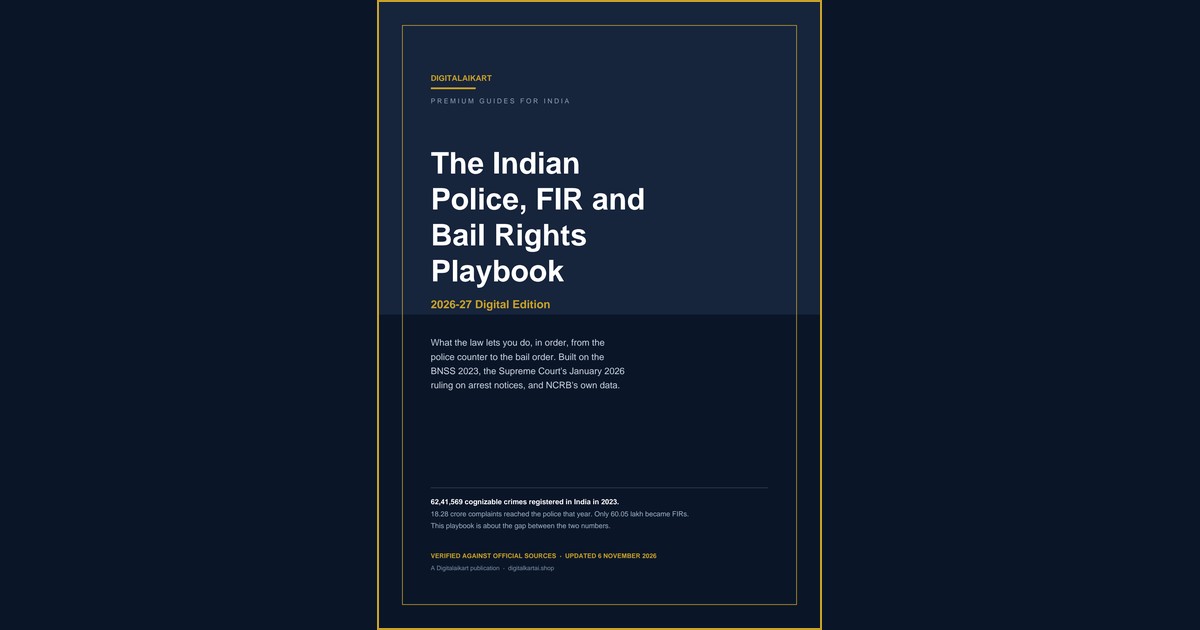
The Indian Police, FIR and Bail Rights Playbook 2026-27 - Digital Edition
New Release · November 2026

The Indian Police, FIR & Bail Rights Playbook

What the law lets you do — in order, from the police counter to the bail order.

India registered 62,41,569 cognizable crimes in 2023, and its police received 1.82 crore complaints. Only 60.05 lakh became FIRs. This 63-page playbook is about the gap between those two numbers: how to give information under BNSS section 173, what to do when the counter says no, what a lawful arrest looks like after the Supreme Court's January 2026 ruling, how bail works across its three doors, and the two entitlements almost nobody claims — victim compensation and free legal aid.

63
Pages
20
Chapters
12
Drafts
8
Helplines
Get Your Copy →
POLICE, FIR & BAIL RIGHTS · DIGITALAIKART
DIGITALAIKART
FIR& BAIL
Rights Playbook 2026-27
2026-27 EDITION63 Pages · 20 Chapters

Who This Is For

Written for the person standing at the counter, not the person arguing in the courtroom

📄

Anyone whose FIR was refused

The complaint was taken, nothing happened, and nobody gave you a receipt. Chapters 7 and 8 are the escalation ladder, with the exact letters and the fourteen-day clock.

🚨

Families after an arrest

The first twenty-four hours, hour by hour: what the memo must contain, who to call, what to say at the production hearing, and how to get a lawyer today.

⚖️

Anyone named in a case

A notice under section 35(3) arrived, or an FIR names you. What the January 2026 Supreme Court order changed, and why the notice is the rule and arrest the exception.

🧾

Small business owners and freelancers

A partner disappears with stock, a cheque bounces, a tenant will not leave. Which door is criminal and which is civil, and how to write the complaint so it is read as a crime and not a money dispute.

What You Will Be Able To Do

Six things most people get wrong, fixed on paper

📝 File an FIR that is registered

The eight elements of a complaint that an officer must act on, the four documents you must not leave the station without, and the wording that turns a grievance into information.

📍 Ask for a zero FIR

The words "irrespective of the area" are now in section 173(1). Scripts for the four refusals you will hear, and what to do the same day if the answer is still no.

🔐 Handle a cyber fraud in the first hour

The 1930 call, the portal, the bank dispute and the FIR — in the right order, with the evidence to preserve and the two mistakes that cost the most.

🚔 Recognise an unlawful arrest

Eight checkpoints from the name badge to the twenty-four-hour rule, each with its BNSS section, and the arrest memo checklist to fill in at the station.

⏱️ Watch the default bail clock

Sixty days, or ninety. The one right in Indian criminal law that needs no argument and no sympathy, and the one that is missed most often.

🆓 Claim free legal aid

All eight categories under section 12, the State-wise income ceilings published by NALSA, and the exact sentence to say in court if you have no advocate.

Inside the Book

Seven parts, twenty chapters, 63 pages — in the order you will need them

  1. The three new codes

    What changed on 1 July 2024, the full CrPC-to-BNSS mapping table, and the four changes that actually matter to a citizen.

  2. Cognizable and non-cognizable

    The one distinction that decides everything, in four boxes, and why a real crime written as a money complaint gets sent away.

  3. 1.83 crore complaints, 60 lakh FIRs

    What NCRB's own complaint table shows, what the gap is and is not, and why the FIR is the only document that unlocks everything downstream.

  4. Filing an FIR under section 173

    Who can file, where, the eight things every FIR needs, what not to write, and the receipt problem with five ways to solve it.

  5. Zero FIR

    The statutory basis, six situations where you insist on it, the script, and the four refusals with an answer to each.

  6. e-FIR and cyber fraud

    The three-day signature rule that voids an online complaint, the golden hour in a financial fraud, and what to preserve from minute one.

  7. When the police refuse

    Section 173(4) letters, section 175(3) applications with an affidavit, the case law on how they must be filed, and a day-by-day escalation calendar.

  8. The preliminary enquiry window

    Section 173(3), its fourteen-day limit, and the three questions that close it.

  9. Arrest, and the 2026 ruling

    Section 35, the Satender Kumar Antil order of 15 January 2026, and the paragraph to memorise if an arrest is threatened.

  10. The first twenty-four hours

    An hour-by-hour table, what the family outside must do in order, and the four failures that matter most.

  11. Interrogation

    What you must answer, what you may decline, why a police statement is unsigned, and the four sentences to say.

  12. Remand and the 60-day clock

    Police custody against judicial custody, what the magistrate should check, and default bail under section 187(3).

  13. Bail: the three doors

    Bailable, non-bailable and anticipatory — the tests, what persuades a court, what gets bail refused, and how sureties work.

  14. Chargesheet, closure, protest

    Section 193 reports, closure reports, protest petitions, and the three documents to ask for at every stage.

  15. How cases actually end

    Trial, plea bargaining, compounding under section 359, witnesses and the Witness Protection Scheme, 2018.

  16. Compensation and free legal aid

    Section 396 victim compensation, the eight section 12 categories, the NALSA income ceilings by State, and Lok Adalats.

  17. Complaints against the police

    Seven channels, what each can and cannot do, and the record you must build before any of them will work.

  18. Ten situations

    Domestic violence, a child, a senior citizen, cyber fraud, cheque bounce, a road accident, a missing person, a tenancy, defamation, and a section 35(3) notice at your door.

  19. Twelve worksheets and drafts

    The incident sheet, the complaint, the SP letter, the magistrate application, the arrest checklist, the bail skeleton and six more — printable and fillable.

  20. Glossary and sources

    Twenty-seven terms in plain English, the official links to check everything yourself, and every source used, with dates.
Why This Edition Is Different

Three things you will not find in the free articles on this subject

⚖️ The January 2026 order

In Satender Kumar Antil v. CBI, decided on 15 January 2026 and reported as 2026 INSC 115, the Supreme Court held that a section 35(3) notice is mandatory for offences up to seven years and that arrest is the exception. Most free guides still quote the 2014 position.

📊 The complaint data, read honestly

1.82 crore complaints, 60.05 lakh FIRs, and a 62 per cent conversion rate on written complaints. The book says what the gap is and what it is not, instead of turning a statistic into an accusation.

🧾 Drafts, not descriptions

Twelve documents with the statutory references already in place: the complaint, the SP letter under section 173(4), the magistrate application under section 175(3) with an affidavit, the bail skeleton, the compensation application.

Get Your Copy

One-time payment · Instant download · Yours to keep and print

Buy With Confidence

Your purchase is protected

⚡

Instant Delivery

Your download link is ready the second your payment succeeds.

🔁

Defective File? Replaced

Corrupted or incomplete file? We replace it within 24 hours — no questions asked.

🔒

Secure Razorpay Checkout

UPI, cards, net banking & wallets — processed on PCI-DSS compliant infrastructure.

Frequently Asked Questions

Everything you need to know before buying

Is this legal advice?

No. It is legal information: the statute, the judgments, the procedures and the drafts, set out in order so that you can understand the system and ask better questions. It does not create a lawyer-client relationship. For anything that could end in an arrest or a charge, speak to an advocate — and if you cannot afford one, Chapter 16 tells you how to get one free, which is an entitlement under the Legal Services Authorities Act, 1987.

Which law does the book follow — the old CrPC or the new BNSS?

The Bharatiya Nagarik Suraksha Sanhita, 2023, in force since 1 July 2024. Every provision is given in its current BNSS number, with a full CrPC-to-BNSS mapping table so that you can translate advice written before 2024. That table alone saves you from quoting section 154 at a counter in 2026.

What is the January 2026 Supreme Court ruling the book covers?

In Satender Kumar Antil v. Central Bureau of Investigation, an order dated 15 January 2026 reported as 2026 INSC 115, the Supreme Court held that a notice under section 35(3) of the BNSS is mandatory for offences punishable with imprisonment up to seven years, and that arrest is the exception rather than the rule. Chapter 9 sets out the ruling and the exact paragraph to say if you or someone you know is facing arrest.

Does the book work in my state?

The statutes are central, so sections 173, 175, 35, 47, 58, 187, 479, 482 and 396 apply everywhere. Where something is state-specific — legal aid income ceilings, victim compensation amounts, police complaints authorities, e-FIR portals — the book says so plainly and points you to the official source instead of printing a number that would be wrong in your state.

I have already been refused an FIR. Is it too late?

No. Chapter 7 gives you the full escalation ladder with dates: a written complaint with a receipt, a speed-post letter to the Superintendent of Police under section 173(4), a follow-up, and then an application to a magistrate under section 175(3) supported by an affidavit. Chapter 8 adds the three questions that close a preliminary enquiry under section 173(3), which has a fourteen-day statutory limit.

How is the PDF delivered?

After payment on Razorpay you are redirected to a thank-you page with a download button. The 63-page PDF downloads instantly and is yours to keep. You can print the twelve worksheets and drafts, and carry them.

Are the facts and figures verified?

Yes, and Chapter 20 lists every source so you can check them yourself. The statutes are from India Code, the judgments from the Supreme Court's reports, the legal aid ceilings from the National Legal Services Authority, and the crime and complaint numbers from the National Crime Records Bureau's Crime in India 2023. Everything was checked on 6 November 2026.

Can I get a refund?

Digital products are non-refundable because they're instantly downloadable. But if you receive a defective or corrupted file, or were charged incorrectly, we'll resolve it — just email lonefaisal977@gmail.com within 7 days.

Pairs Well With

Readers of this playbook usually keep one of these alongside it

The Consumer Rights & Refund Playbook

For disputes with a seller or a service provider — the civil side of the same instinct to hold someone accountable.

The Cyber Fraud Survival Playbook

The full treatment of online fraud, from the 1930 call to the bank dispute and the chargeback.

The Loan Default & Recovery Rights Playbook

The other side of the same room: what a lender can and cannot do when you cannot pay.

Browse all Digitalaikart products →

Know what to say at the counter

63 pages · 20 chapters · 12 printable drafts — start reading in 60 seconds.

Get Your Copy →

Get new AI guides & tips first

One short email whenever we publish something genuinely useful — new AI guides, tools and India-specific playbooks. No spam, unsubscribe anytime.