Own the name you built — before someone else registers it.
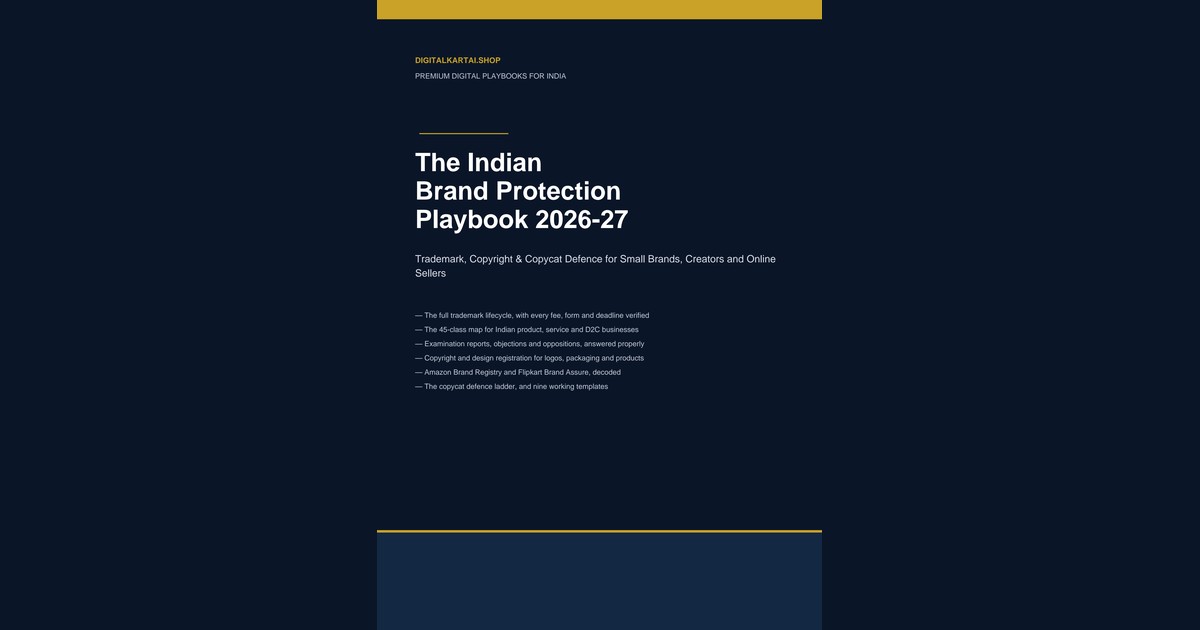
The 36-page playbook for protecting a brand name in India. Clearance search and Form TM-A, the 45-class map for real Indian businesses, examination reports and oppositions answered properly, copyright and design registration, Amazon Brand Registry and Flipkart Brand Assure, and the copycat defence ladder. Every fee, form and deadline verified from IP India, the Trade Marks Act, the Copyright Act, the Designs Act, WIPO and the marketplace programmes, October 2026.
Get Your Copy →Built for anyone whose name is the asset
You print packaging, list on marketplaces and compete on the name. This is the sequence from name choice to registration, with the class map for your category.
Brand Registry and Brand Assure decoded — the exact-match rule, the permanence test, what each platform accepts, and why one takes a pending mark and the other does not.
Your notes, recordings, artwork and code are separate copyright works with separate owners. Part 10 and Part 12 cover what you actually own and how to fix it.
Clients ask who owns the work. The assignment and IP-clause templates in Part 18 answer that in writing, in language both sides can sign.
Six things most Indian brands get wrong, corrected with the actual rules
Exact, phonetic, contains, related-class and Vienna-code searches — the five passes that catch what a single exact-match lookup misses.
Which classes 20 different Indian business types actually need, and why the retail-services class is the one D2C brands forget.
The nine portal steps, every document to gather first, and the fee at each stage — ₹4,500 or ₹9,000 per class, plus renewal, opposition and expedited examination.
Section 9 versus Section 11, the one-month reply window under Rule 33(4), the single extension available, and the reply structure that works.
Amazon Brand Registry on a pending mark, Flipkart Brand Assure on a registered one, Transparency, and the packaging rules that decide approval.
The six-step ladder from platform complaint to criminal complaint, the evidence pack to build before you need it, and the nine templates to send.
20 parts — from the first clearance search to the fee sheet
The three failures that cost Indian brands their names, and what protection actually buys you.
Trademark, copyright, design and passing off — what each protects, its term, and which to file first.
The distinctiveness spectrum, the Section 9(2) traps, Section 14 on living persons, and the six-pass search.
The class map for 14 business types, specification drafting, and who qualifies for the ₹4,500 rate.
Documents to gather, the nine portal steps, use claimed versus proposed, and the full fee table.
Why the word mark is usually the right single filing, and the exact-match rule that decides your Amazon listing.
Reading Section 9 and Section 11 objections, the one-month deadline, the extension, and the reply that works.
The full opposition timetable, the defaults that abandon an application, and why consent letters end most disputes.
TM versus the registered symbol, the Section 107 penalty, renewal costs, non-use removal, and recording changes.
Form XIV, the exact fees, the TM-C certificate logos need, the 30-day window, and the criminal penalties.
Form 1 at ₹1,000, Locarno classes, the ten-plus-five year term, and the fifty-reproduction boundary.
The three documents every brand needs, the clauses that matter, and how to fix work already delivered.
Side-by-side requirements, the permanence test, Transparency, and what the programmes do not do.
The eight-item evidence pack, the six-step ladder, what a cease-and-desist must contain, and the counter-attack to expect.
The Madrid Protocol route, the WIPO fee structure, the five-year dependency, and when national filings win.
A day-by-day sequence, plus lean, standard and full budgets with every government fee itemised.
Skincare, food, clothing, SaaS, coaching and local services — the first move for each, and its specific trap.
Nine working documents: clearance worksheet, specification sheet, reply skeleton, cease-and-desist, takedown notice, IP assignment, employment clause, evidence log, deadline tracker.
Twenty-two straight answers, from "is a company name a trademark" to "what if my designer refuses to sign".
Every government fee in one table, twenty-four defined terms, and the primary sources used.
Government fees, per class, e-filing, 2026
The Udyam certificate is free and halves the trademark and design fee for the life of the business. It is the highest-return twenty minutes available to an Indian small brand, and Part 4 shows exactly how it changes your filing cost.
One-time payment · Instant download · Yours permanently
Your purchase is protected
Your download link is ready the second your payment succeeds.
Corrupted or incomplete file? We replace it within 24 hours — no questions asked.
UPI, cards, net banking & wallets — processed on PCI-DSS compliant infrastructure.
Everything you need to know before buying
Legally, no. Commercially, you need one before you build a brand you would mind losing. Without a registered mark you cannot sue for infringement, cannot enrol in Flipkart's Brand Assure, and cannot use Amazon Transparency. Amazon Brand Registry does accept a pending application — that is the fastest partial protection available, and Part 13 shows how to use it.
No. A company registration with the Ministry of Corporate Affairs only stops another company registering the identical name at MCA level — it does nothing to stop a different business using a similar brand on products or a marketplace. GST registration is a tax registration. Only a registered trademark gives exclusive rights in a name for specific goods or services.
On Form TM-A filed online, ₹4,500 per class for individuals, DPIIT-recognised startups and micro, small or medium enterprises with a Udyam certificate, and ₹9,000 per class for everyone else. The fee is per class and per mark, and it is non-refundable. Renewal every ten years is ₹9,000 per class.
The registry does not promise a fixed total duration. The stages are examination, publication in the Trade Marks Journal, a four-month opposition window, and registration if no opposition is filed. Expedited examination under Rule 34 is ordinarily completed within three months of the request, at ₹20,000 per class for individuals, startups and small enterprises, or ₹40,000 for others.
Yes. Part 10 covers copyright — the Form XIV filing, the ₹2,000 rate for an artistic work used with goods and services, the ₹9,000 TM-C search certificate that logo filings require, and the 30-day objection window. Part 11 covers design registration for shapes and packaging at ₹1,000 on Form 1 for individuals, startups and small entities.
Yes, and more urgently. Part 3 is the search you should have run, Part 5 is the filing you can still make, Part 7 is the examination report you will receive, and Part 14 is what to do when someone is already copying you. The templates in Part 18 include a retroactive IP assignment for work already delivered.
No. It is a researched, source-verified working manual, not legal advice, and it does not create a lawyer-client relationship. For an opposition, a live dispute, a high-value brand or anything already in litigation, instruct an advocate. The playbook says so plainly in its own front matter.
Every figure was checked against primary sources in October 2026 — the First Schedule to the Trade Marks Rules, 2017, the Copyright Rules, 2013, the Designs Rules as amended in 2021, WIPO's Madrid schedule, and the live Amazon and Flipkart programme pages. Fees change by notification, so the playbook tells you where to confirm before filing.
After successful payment on Razorpay you are redirected to a thank-you page with the download button. The PDF is yours permanently.
Digital products are non-refundable because they are instantly downloadable. But if you receive a defective or corrupted file, or were charged incorrectly, we will replace or resolve it — just message us within 7 days.
WhatsApp us on +91 96826 00301. We typically respond within 24 hours.
Brand owners usually pair this with one of these
Once the brand is registered, the tax registration and invoicing have to be right too — rates, returns and the small-business thresholds.
Your customer database is the other asset you own. This covers consent, notices and the data-protection obligations of a small business.
Copycats generate complaints, and complaints reach you as well as them. Know what you owe a buyer, and what you do not.
36 pages · 20 parts · 9 templates · every fee verified from IP India — start reading in 60 seconds.
Get Your Copy →