Start a food business from home — with real 2026 numbers, not guesswork
A 31-page India playbook for a home tiffin service or a delivery-only cloud kitchen. It sets out the three business models, the full unit economics of one app order, FSSAI's April 2026 licensing overhaul, GST and section 9(5), the real Swiggy and Zomato commission maths, the low-commission ONDC route, the fill-in worksheets, and a 30-day launch plan. Every rule and figure verified against official and current 2026 sources.
Get Your Copy →Built for anyone who wants to earn from cooking — without a restaurant
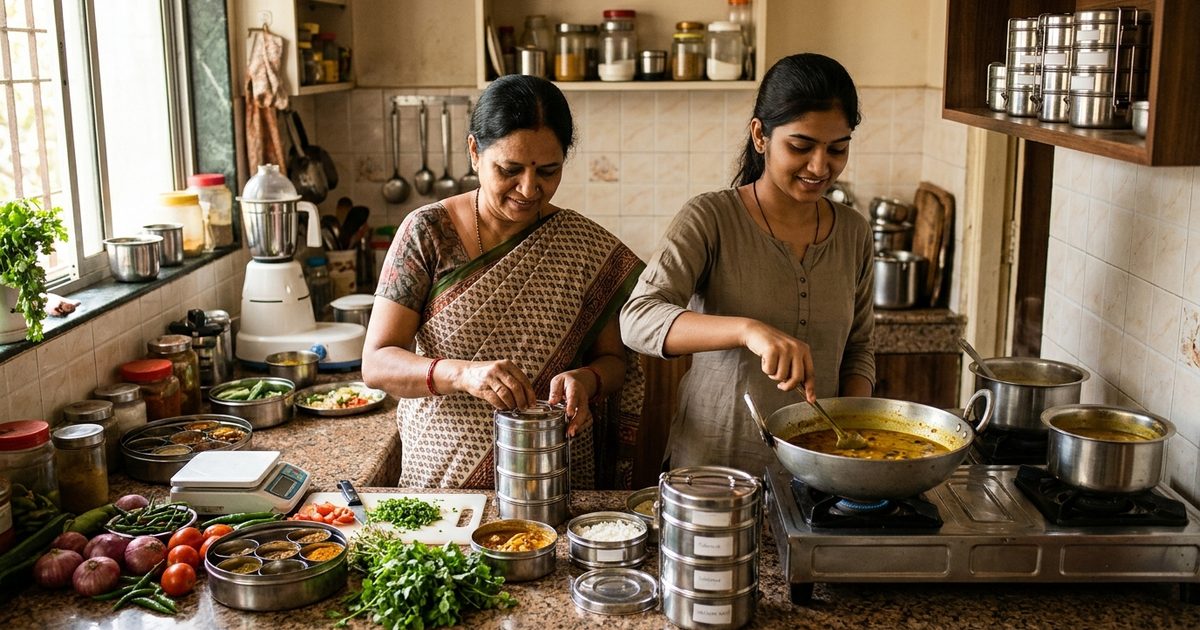
Turn your kitchen into a monthly subscription business — pricing bands, route density, pause/skip rules and the first 30 customers on WhatsApp.
Start with under ₹50,000 from a home kitchen, prove the food sells, then reinvest. No lease, no commission, no big risk.
Already cooking and losing money? The unit-economics chapter shows exactly where the margin leaks and how to fix the pricing.
Going for a standalone cloud kitchen? Model the capex, the commission, the break-even orders a day and the virtual-brand decision first.
Six things that decide whether your kitchen makes money
Home tiffin, shared kitchen slot or standalone cloud kitchen — compared on cost, reach, risk and who each one suits.
The full unit economics of one ₹250 order — commission, GST on commission, payment fee, food, packaging — and what's really left.
FSSAI's April 2026 overhaul, section 9(5), section 24(ix), the 5% restaurant rate and the four local registrations — in order.
What travels well, how to cost one dish properly, and the 15-25% delivery mark-up that lets you survive the commission.
The WhatsApp engine for your first 30 customers, Swiggy and Zomato onboarding, the ONDC channel, and your own direct-ordering lever.
A week-by-week launch grid plus four fill-in worksheets — startup cost, per-dish costing, monthly P&L and a customer tracker.
10 parts — from the market to your first profitable month
India's delivery market in numbers, why the festive season is the best launch window, and the three ways in.
Home tiffin subscription, shared kitchen slot, standalone cloud kitchen, and the one-brand-or-several decision.
Startup costs by model, the unit economics of one order, what leaves your account, pricing to survive, and break-even.
FSSAI after April 2026, GST and section 9(5), the other four registrations, and your compliance calendar.
The delivery-friendly menu, costing one dish, tiffin pricing bands, and packaging that protects your rating.
The WhatsApp engine, Swiggy and Zomato onboarding, ONDC, your own ordering channel and photography.
The daily kitchen rhythm, delivery options, ratings and refunds, and the weekly reconciliation habit.
A week-by-week grid from decision to first order, with what success looks like at day 30.
Startup cost estimator, per-dish costing sheet, monthly unit-economics sheet and a first-30-customers tracker.
The twelve mistakes that kill Indian kitchens, 20 straight answers, and a sources page.
One-time payment · Lifetime access · No subscriptions
Your purchase is protected
Your download link is ready the second your payment succeeds.
Corrupted or incomplete file? We replace it within 24 hours — no questions asked.
UPI, cards, net banking & wallets — processed on PCI-DSS compliant infrastructure.
Everything you need to know before buying
Yes, but it must be registered. Any food business selling to the public in India, including a home tiffin service, needs FSSAI registration through the FoSCoS portal. Home cooks are not exempt once they sell commercially.
From 1 April 2026 the turnover thresholds were raised sharply. Basic Registration now covers turnover up to Rs. 1.5 crore at about Rs. 100 a year, State Licence covers above Rs. 1.5 crore up to Rs. 50 crore, and Central Licence applies above Rs. 50 crore. Licences issued from 1 April 2026 have perpetual validity, but the annual fee must still be paid.
Yes. Every rule, fee and threshold was checked against official and current 2026 sources — FSSAI's licensing amendment effective 1 April 2026, CBIC/CGST provisions, and current platform and market data — as of October 2026.
After a successful payment on Razorpay, you'll be automatically redirected to a thank-you page with a download button. Click it to get your PDF instantly — it's yours forever.
The widely held reading is that once you supply restaurant service through an e-commerce operator, GST registration becomes mandatory regardless of turnover, under section 24(ix). The book explains the section 9(5) rule that makes the platform pay the 5% GST on app orders, and the 5% no-ITC restaurant rate. Confirm your specific position with a chartered accountant.
No. The playbook explains how the rules and the numbers work as of October 2026, but it is not professional advice and fees and thresholds change. Before you register, list or sign a platform agreement, confirm the current position with FSSAI, the GST portal, your municipal body and your own chartered accountant.
Digital products are non-refundable because they're instantly downloadable. But if you receive a defective or corrupted file, or were charged incorrectly, we'll replace or resolve it — just email lonefaisal977@gmail.com within 7 days.
Email us at lonefaisal977@gmail.com or message us on WhatsApp at +91 96826 00301. We typically respond within 24 hours.
The mind behind the guide
Readers starting a food business usually add one of these
Set up Meta's free Business AI on WhatsApp to answer menu and order questions automatically — the natural companion to the direct-ordering channel in Part 6.
Payment protection, GST-ready invoices and follow-up scripts — useful once you are billing offices and corporate catering clients.
Sell more through the festive season — gifting, offers and pricing — a good fit for Diwali-week bulk food orders.
31 pages · 10 parts · 4 worksheets — start reading in 60 seconds.
Get Your Copy →