01.The Growing Promise of Agricultural AI
Artificial intelligence is steadily moving to the forefront of discussions around modernising India's agricultural sector. From crop health assessment and soil condition monitoring to market price forecasts and weather predictions, automated systems promise to streamline critical decisions. For Indian students, technologists, and entrepreneurs, building solutions for rural communities represents a massive opportunity to deploy cutting-edge computer science where it can make a tangible difference.
However, the path between designing an algorithm in an academic or industrial laboratory and generating actual value in an Indian field is complicated. While technical benchmarks and model accuracy metrics often look promising in isolated tests, actual deployment in rural settings frequently reveals a stark mismatch between what technologists build and what cultivators genuinely need.
02.The Disconnect Between Labs and Real Fields
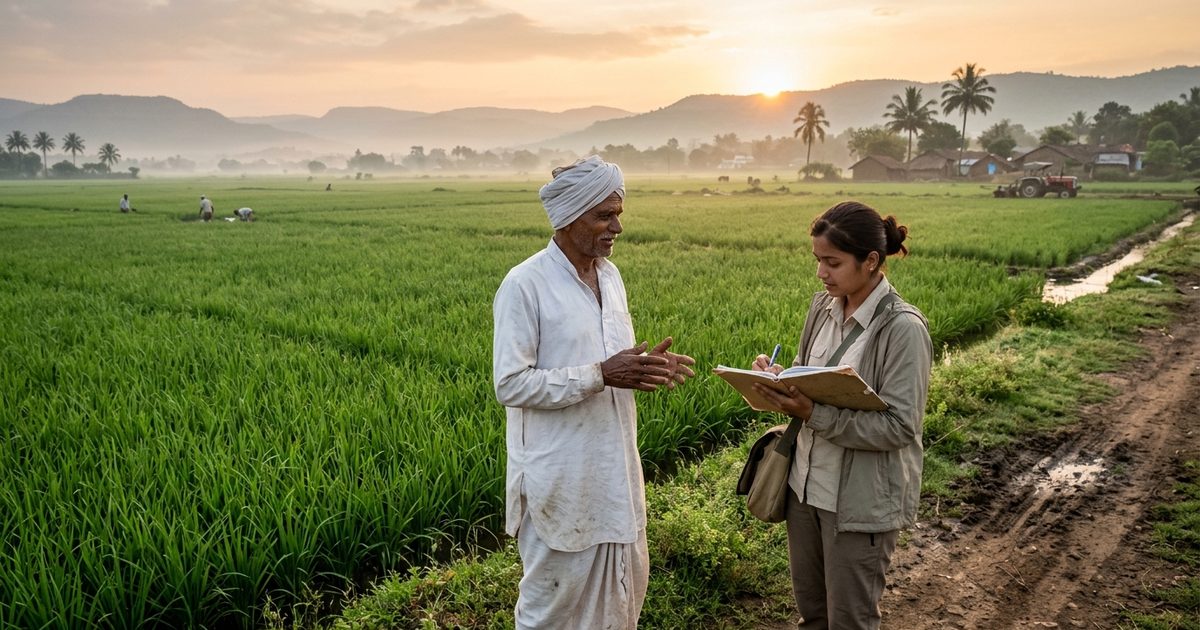
A major limitation in current agricultural AI development is the top-down nature of the research process. Many data science teams approach agriculture from a distance, focusing heavily on raw datasets, remote sensing feeds, and theoretical models without deeply engaging with the people who will actually interact with the final product. As highlighted by ongoing discussions in the research community, before artificial intelligence can offer meaningful assistance to Indian farmers, research teams must first learn to listen to them.
Farming in India is not a uniform operation that can be optimised through a single generalised algorithm. Microclimates, varied soil chemistry, regional crop varieties, water access disparities, and local market structures create vastly different operating environments. When researchers build solutions without direct dialogue with local growers, the resulting software often fails to account for everyday constraints, such as fragmented landholdings, unpredictable irrigation availability, and regional language nuances.
03.Why Listening Is Essential for Adoption
Listening to farmers is not merely an ethical consideration; it is a fundamental engineering requirement. Cultivators hold generations of observational knowledge regarding pest behaviour, seasonal shifts, and soil responses that standard datasets rarely capture. When AI research ignores this tacit knowledge, recommendations generated by automated systems can feel impractical, confusing, or outright unhelpful to experienced farmers on the ground.
Moreover, trust remains the decisive factor in whether any digital advisory tool gets adopted. Farmers operate under tight financial margins where a single flawed recommendation regarding fertiliser dosage, pesticide application, or sowing schedules can ruin an entire season's livelihood. When researchers take the time to listen, understand local risk tolerances, and co-design systems that solve actual pain points, adoption rates naturally improve.
04.The Imperative for Participatory Research
For Indian developers, startups, and academic institutions, the message is straightforward: the future of agritech lies in participatory research. Instead of developing models in isolation and treating end users as passive recipients, engineering workflows must incorporate continuous feedback loops from the very beginning of the product lifecycle.
This participatory approach requires building systems that accommodate diverse local languages, low-bandwidth environments, and intuitive interfaces. When research prioritises two-way communication over one-sided technological imposition, artificial intelligence can transform from an academic experiment into a dependable, field-ready asset for rural India.
Frequently asked questions
Why is listening to farmers critical for AI researchers?
Farmers hold essential contextual knowledge about local soil, weather, and operational risks that digital datasets miss. Direct communication ensures automated tools solve real problems rather than theoretical ones.
What challenges do agricultural AI tools face in rural India?
Tools often struggle with diverse microclimates, lack of local language support, and high financial risk margins that make growers cautious of unverified advice. Field-level mismatches often lead to low software adoption.
How can AI developers improve agricultural solutions?
Developers should implement participatory research models that consult farmers during design and testing. Building accessible interfaces that account for local constraints ensures tools are practical and trustworthy.