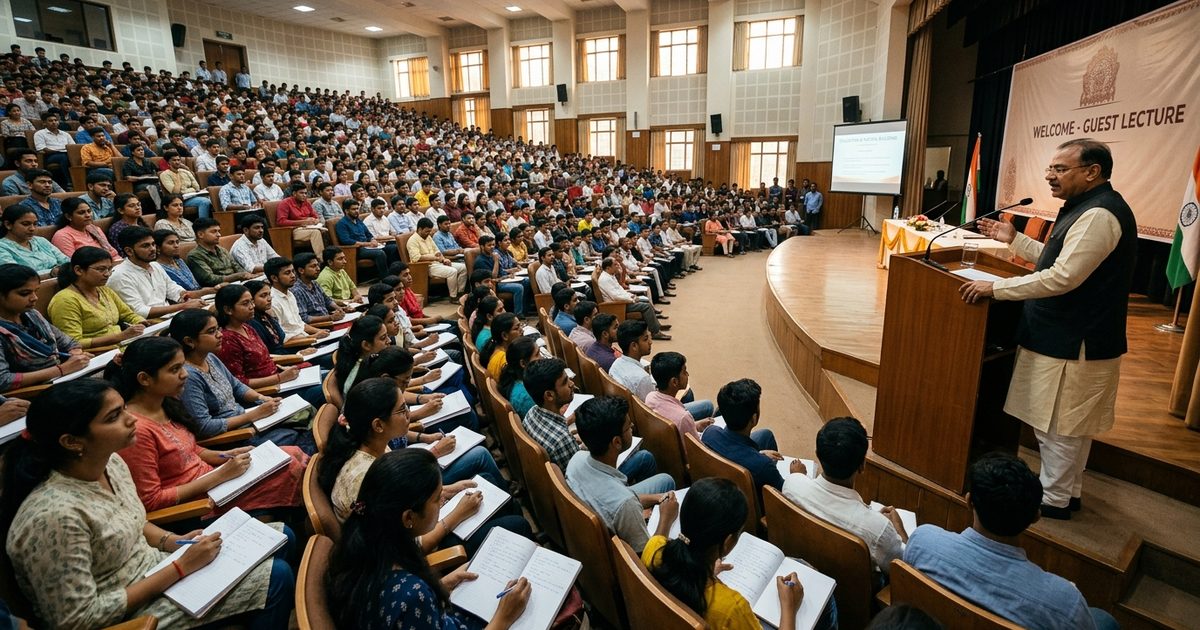
01.What Goyal said at SRCC
Union Commerce and Industry Minister Piyush Goyal told students on Thursday that artificial intelligence is more likely to add jobs in India than take them away. He was speaking at Shri Ram College of Commerce in Delhi at an event on the theme Pathways to Viksit Bharat, where much of his address turned to technology and the future of work.
I think artificial intelligence will not reduce jobs. It may actually increase the number of jobs available for our young Indian brothers and sisters, he said. He added that while the nature of jobs may change, more high-paying roles would become available for everyone. His message to the gathering was that India should treat AI as a tool for growth, and not as a reason to hold back its young workforce.
02.Why his remarks matter now
The minister's comments come at a time of growing concern about how AI will affect jobs, especially in technology and services, which are major sources of employment in India. Questions have been raised in policy circles about whether AI could shrink entry-level work in software, back-office operations and customer support, areas that have absorbed large numbers of young graduates over the past two decades. The worry is not confined to India, since firms around the world are weighing how quickly AI tools can take over routine tasks and how many new roles they will create in their place.
Goyal did not brush those worries aside. He acknowledged that the shift to AI-driven workplaces could bring uncertainty for a short period of time as existing roles are redesigned and rewritten. The answer, he said, is to train and skill young Indians for the new kinds of work that the technology creates, rather than to resist the change or pretend it is not coming. He framed skilling as the bridge between the jobs that exist today and the ones that will exist tomorrow.
03.The skilling message for students
Much of the minister's advice was aimed directly at the students in the hall, a group that will soon enter a job market already being reshaped by AI. He said India needs young people who can build and run AI-based systems, and who can become masters of cybersecurity, describing these as the roles of the future. In his view, preparing for that shift is the way to turn a disruptive technology into an opportunity rather than a threat.
He drew a parallel with India's information technology boom of the 1990s and 2000s, when the country gained enormously by adopting and servicing technologies that had been developed elsewhere. This time, he argued, India should go further and build its own AI solutions, turning large language models into practical tools that businesses and ordinary citizens can actually use in daily life. That, he suggested, is where the country can create both economic value and employment at the same time.
04.The jobs AI may not replace
Goyal pointed to tourism, sports and services built around human experience as areas that would keep offering work beyond AI's reach. These sectors, he said, depend on personal interaction and real-world experiences that machines cannot easily copy, and so they will continue to need people even as automation spreads through other parts of the economy. He did not claim that every other sector is safe, but singled out experience-driven work as the part of the economy that would stay firmly human.
He also said that wider adoption of AI and other modern technologies could lift India's productivity, efficiency and competitiveness in global markets, which in turn could open up fresh employment. Better technology, in his framing, is a way to grow the economy and raise incomes rather than a reason for the workforce to shrink. For small businesses and large firms alike, that view points to using AI to do more, instead of simply using it to cut headcount.
05.What it means for India's economy
The minister tied the AI discussion to the wider economy, saying globalisation is not coming to an end but changing its nature, with companies increasingly looking for resilient supply chains and trusted partners among nations. He said India is well placed to benefit as businesses seek reliable manufacturing destinations and stable economic partners around the world, and pointed to the country's large domestic market and skilled workforce as advantages in that shift.
He added that India's future growth would depend on investment in manufacturing, the adoption of new technologies and faster development of regions that have traditionally lagged behind. Goyal said he was confident India could remain the fastest-growing large economy for the next 20 to 25 years, supported by its young population, expanding market and growing technological capability. For students and working professionals, the practical message is that keeping AI skills current will matter as much as the technology itself.
Frequently asked questions
Will AI reduce jobs in India?
Commerce Minister Piyush Goyal said AI may actually increase the number of jobs in India rather than reduce them. He accepted that some roles will be redesigned and workers will need new skills during the transition.
What skills did Goyal say young Indians should build?
He said young people should learn to build and run AI-based systems and become experts in cybersecurity. He described these as the kinds of new, higher-paying roles that the technology will create.
Which jobs does Goyal think AI cannot replace?
He pointed to tourism, sports and services that depend on human experience. These would keep offering work, he said, because they rely on personal interaction that machines cannot easily copy.