01.Google's next bet: AI that reaches the ground
On October 15, Google announced a set of new India initiatives spanning crop science, education, agriculture and economic inclusion, saying frontier research should be deployed to deliver population-scale progress. The announcements came in a post by Preeti Lobana, VP and Country Manager, India, Google, and Lila Ibrahim, Chief AI Readiness Officer at Google DeepMind.
Rather than a new chatbot or a fresh benchmark score, the day's news was about partnerships with a Hyderabad crop-research institute, state governments and a Bengaluru non-profit, aimed at farmers, teachers and small businesses. That framing matters in India, where AI adoption is judged less by model rankings and more by whether it improves a crop, a classroom or a shop. It also underlines how global AI firms are competing for India's adoption, not only its engineering talent.
02.A genetic atlas for jowar, and global food security
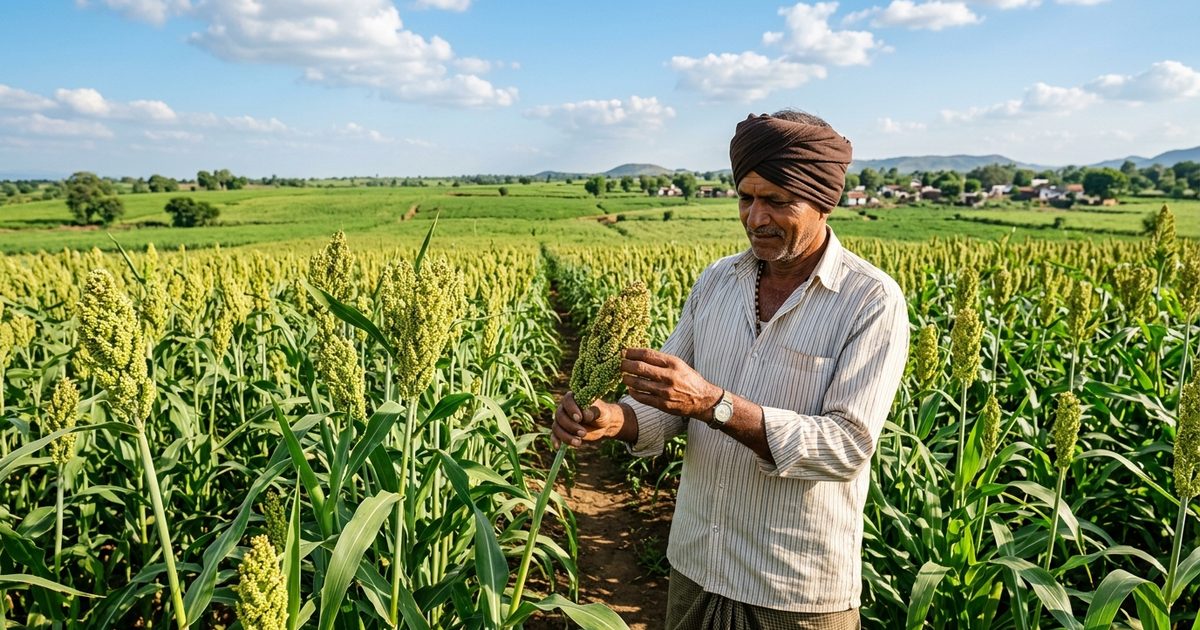
Climate change is straining food systems, and climate-resilient, nutrient-rich crops such as sorghum (jowar) matter most in vulnerable dryland areas. Google DeepMind and Google.org, through the AI Collaborative for Food Security, are working with Hyderabad-headquartered ICRISAT, the HudsonAlpha Institute for Biotechnology and the Department of Genome Sciences at the University of Washington, Seattle, to build an open-access genetic atlas of sorghum.
The atlas will draw on a representative sample from ICRISAT's genebank of more than 44,000 distinct seeds from over 90 countries, including India. It pairs advanced genetic analysis with machine learning to identify the most promising plant combinations, helping breeders develop more resilient and productive sorghum varieties faster than traditional methods that can involve decade-long trial and error. Google DeepMind will also fund a three-year postdoctoral fellowship at ICRISAT, its first in India and first outside the UK, to build similar genome tools for pulses such as chickpea, groundnut and pigeon pea.
03.From Gujarat farms to a public preview
Google's AnthroKrishi team's India-first Agricultural Understanding models already provide insights for 11 countries. In Gujarat, Amnex integrated the agri model APIs into the state's Krushi Pragati crop intelligence platform, which supported over 900 million SMS-based advisories for more than 600,000 farmers in the past year, covering crop and soil health, pest and disease management and weather patterns across over 14 million hectares.
OpenAgriNet, a coalition seeded by the EkStep Foundation, has used the APIs for an analytics dashboard for agricultural administrators and is exploring a farmer-facing application in the user's chosen language. Google is now expanding access to its Agricultural Understanding models, making them available in public preview so developers, startups and researchers can build hyperlocal solutions for smallholder farmers at scale. For Indian startups, that lowers the friction to build tools in local languages for real farming conditions.
04.Teachers get time back, students get better tools
The Google AI Educator Series, launched in May with five state and regional partners, has already trained more than 80,000 educators, helping them use Gemini and Gemini Notebook to design lesson plans, create learning aids and streamline daily preparation. It is expanding through new partnerships with Bihar, Madhya Pradesh and Sikkim, and with the Ministry of Skill Development and Entrepreneurship.
Google is also releasing the programme as free, online, self-paced training aligned with NEP 2020. It is available now in English, with Hindi, Marathi, Telugu, Assamese, Odia and Punjabi versions arriving later this month. The company will additionally support educators across 100 Atal Tinkering Labs through ATL Saathi, a Gemini-powered desktop application for STEM curricula, and is partnering with institutions including IIT Bombay and the Office of the Principal Scientific Adviser. For teachers, the practical payoff is time: less spent on preparation, more on mentoring students.
05.Backing India's small businesses
India's more than 90 million micro, small and medium enterprises (MSMEs) employ over 345 million people but face persistent hurdles in accessing credit, finding markets and managing compliance. Google.org is providing $15 million in funding to Bengaluru-based The/Nudge to accelerate their growth, supporting scalable AI tools in exactly those three areas.
The programme will feature an open call for proposals and a multilingual, voice-led platform to train local talent in Tier 3 and Tier 4 towns and connect them directly with small businesses. Taken together, the announcements point to a shift in emphasis, from building ever-larger models to putting AI to work in farms, classrooms and small firms. For India's smaller businesses, the bet is that AI tools can cut the cost of winning formal credit and reaching new buyers.
Frequently asked questions
What did Google announce in India on October 15, 2026?
New initiatives across crop science, education, agriculture and economic inclusion: a sorghum genetic atlas with ICRISAT, a public preview of its Agricultural Understanding models, an expanded teacher-training programme, and $15 million for MSMEs through The/Nudge.
Which crops does the ICRISAT partnership cover?
The genetic atlas focuses first on sorghum (jowar). A new three-year postdoctoral fellowship at ICRISAT will extend similar genome tools to pulses such as chickpea, groundnut and pigeon pea.
How do Indian farmers benefit from this today?
Google's agri model APIs already power Gujarat's Krushi Pragati platform, which delivered over 900 million SMS advisories to more than 600,000 farmers in the past year. The models are now in public preview for developers and researchers.