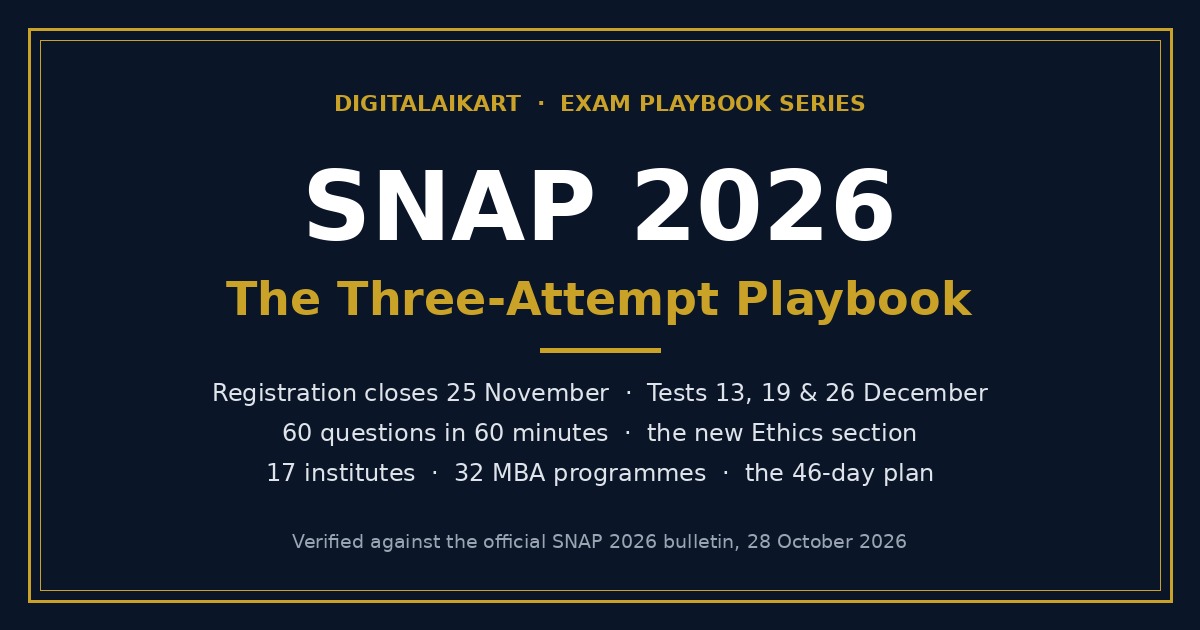
Registration closes 25 November. Three tests, one best score, 46 days.
The 31-page playbook for the SNAP 2026 cycle — the registration portal walked through step by step with the real fee maths, the three-attempt strategy that most candidates waste, the 60-question paper decoded question by question, the new Ethics, Morality and Values section with a 20-dilemma bank, a 25-question timed self-test with full reasoning, the 17-institute matrix with published deadlines, the fee and ROI tables, and the 46-day plan from today to 13 December. Every date, fee and weightage verified from the SNAP 2026 bulletin and the official institute admission pages, 28 October 2026.
Get Your Copy →Built for the candidate inside the deadline
You know the exam exists and not much more. Sections 1 to 4 get you registered, paid up and pointed at the right programmes before 25 November.
A dated plan from 28 October to 13 December, plus an 18-day compressed version for anyone who registers in the last week.
You missed last year by a margin. The three-attempt strategy, the error-log protocol and the pacing maths are where the marks usually are.
SNAP is your second or third shot this season. The paper is 60 questions in 60 minutes — this is the shortest route to a valid December score.
Twenty-six sections, no padding
Registration closes 25 November. Three tests on 13, 19 and 26 December. Two separate fees. 60 questions in 60 minutes. Half the merit score decided in February.
What a three-attempt, three-programme application really costs with GST — and the two fees that disqualify candidates who pay only one.
How to sequence 13, 19 and 26 December, what attempt one teaches you that no mock can, and a decision rule for the day after each paper.
The negative-marking maths that says a blind guess is worth +0.06, an accuracy-to-net-score table, a minute-by-minute pacing plan and the two-pass method.
General English, Analytical and Logical Reasoning, Quantitative with Data Sufficiency — target times per question type and when to walk away.
10 marks nobody has prepared for: a five-step method, the four question shapes, a one-week plan and 20 dilemmas with model reasoning.
Sat in 25 minutes in the proportions of the real paper, with a full answer key and the reasoning behind every answer.
17 institutes, 32 programmes, six cities — with the programme registration deadlines, shortlist dates and GE-PI windows that are actually published.
Published programme fee structures side by side, two-year outlays calculated, and five questions to ask before you accept a seat.
The 50 + 10 + 40 composite score explained, five group-exercise formats, and twenty interview questions to write answers for.
The colour printout, the photograph rule, the six accepted IDs, what is banned at the centre, and the two documents that decide your February.
What SIU says about agents, guaranteed seats and capitation fees — plus where to escalate a payment that goes wrong.
All 26 sections, in order
The frame: two deadlines, two fees, one paper, half a merit score.
The fourth section, the passed early-registration window, and why the paper is shorter in attention than in difficulty.
Twelve steps, the DD trap, the realised-payment rule, and what three attempts plus three programmes costs with GST.
Best score counts, no normalisation — how to use attempt one as live calibration and attempt three as a real shot.
Expected-value maths, the accuracy table, the pacing plan and the two-pass method.
A ten-statement audit with score bands and the first thing to fix at each level.
Ten marks in nine minutes, and the two habits that cost most candidates two of them.
Six question families, target times, and the skip rules that decide a 12 from an 18.
The arithmetic-led syllabus, the 23-minute split, and why DS is the cheapest marks in the paper.
The five standard options, then six questions worked through with the reasoning.
What is verified, what is not published, the four question shapes and a five-step method.
Workplace, campus and family-business situations with model reasoning for each.
Build, convert, taper — dated weeks, weekly outputs, and the 18-day version for late registrants.
A 25-minute review, a printable log grid and three rules for using mocks honestly.
Twelve topics on one page, to be written from memory twice a week.
Five English, six reasoning, eight quantitative and DS, six Ethics — with a full answer key.
17 institutes, 32 programmes, six cities, and the deadlines that fall before the result.
The Rs 1,000 decision, a portfolio that makes sense, and the eligibility differences that change your list.
Published fee structures, two-year outlays, and five questions before you accept a seat.
Why 40 of the 100 marks sit in an interview room in February.
Five group-exercise formats and twenty interview questions to prepare in writing.
What to carry, what is banned, the reporting timeline and the PwD provisions.
A two-day schedule for arriving rested, documented and calm.
SIU's own position on guaranteed seats, and the three approaches to refuse.
The audit list to re-read weekly until the paper.
Today, this week, by 24 November, by 13 December, after 12 January.
Every figure traceable, every gap admitted
Dates, fees, section structure, admit-card rules and exam-day instructions come from the SNAP 2026 bulletin itself.
Deadlines and fee structures are taken from SIBM Pune, SIIB, SCMHRD, SIMS, SICSR, SSBF and SCIT — with the source named under every table.
Symbiosis does not publish official cut-offs. The playbook says so plainly instead of quoting a percentile that does not exist.
One-time payment · Lifetime access · Instant download
Your purchase is protected
Your download link is ready the second your payment succeeds.
Corrupted or incomplete file? We replace it within 24 hours — no questions asked.
UPI, cards, net banking & wallets — processed on PCI-DSS compliant infrastructure.
Everything you need to know before buying
That is exactly who it is written for. Section 3 walks through the registration portal step by step, including the two separate fees most candidates miss, and section 4 helps you decide whether to book one, two or three attempts before the 25 November deadline.
From the SNAP 2026 bulletin published by Symbiosis International (Deemed University), the official snaptest.org site, and the admission calendars published by SIBM Pune, SIIB, SCMHRD, SIMS, SICSR, SSBF and SCIT. Everything was checked on 28 October 2026. Where an institute has not published a figure, the playbook says so instead of guessing.
Yes — two full sections. One teaches a five-step method for value dilemmas, and the other is a bank of 20 workplace and campus dilemmas with model reasoning, written because SIU has not published a chapter-wise syllabus for the new 10-mark section.
Yes. Section 16 is a 25-question self-test in the proportions of the real paper — five English, six reasoning, eight quantitative and Data Sufficiency, six Ethics — to be sat in 25 minutes, with a full answer key and the reasoning behind every answer. Section 10 adds six worked Data Sufficiency examples.
Sections 17 to 24 cover the part most guides skip: the 17 institutes and 32 programmes, programme registration deadlines that fall before the result, published fee structures, the 50 + 10 + 40 composite merit score, GE-PI preparation with 20 interview questions, and the exam-day checklist.
All three. The plan covers 28 October to 26 December, including what to do in the six days between tests and how to decide whether to sit a second or third attempt.
After a successful Razorpay payment you are redirected to a thank-you page with the download button. The PDF is yours forever, and you can download it again any time from that page.
Digital products are non-refundable because they download instantly. If your file is corrupted, incomplete or you were charged incorrectly, message us within 7 days and we will fix or replace it.
No. It is an independent study guide. It is not published by, endorsed by or affiliated with Symbiosis International (Deemed University). The SNAP bulletin and the institutes' own websites are always the final authority.
If you are preparing for more than one entrance exam this season
The 74-day sprint for CAT on 29 November — VARC, DILR and QA playbooks, the 3:1 mock rule and the taper to exam morning.
The 73-day plan for CLAT on 6 December — five section playbooks, the scoring maths and the counselling process.
60 copy-paste AI prompts for your resume, LinkedIn, interviews and salary negotiation, built for the Indian job market.