Twelve chip plants. Nine job families. One route in — written for the person outside the gate.
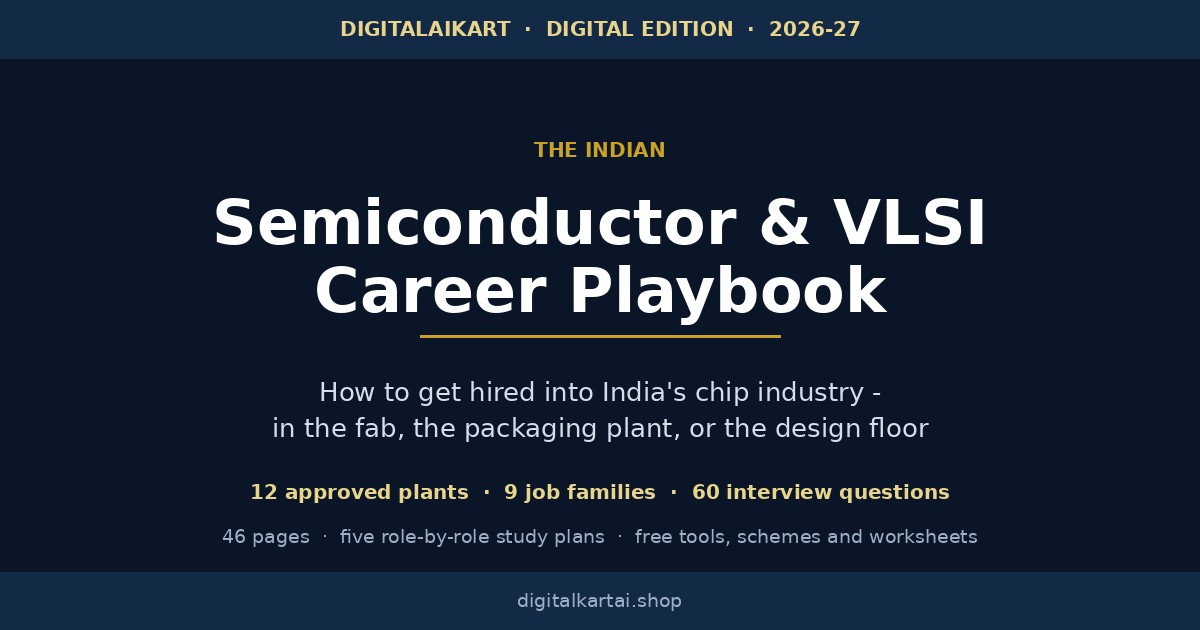
India has twelve approved semiconductor plants, five of them already shipping product, and a second mission worth Rs. 1,27,500 crore that funds training on purpose. This 46-page playbook explains what those plants actually do, which of the nine job families hire freshers, what each pays in 2026, and then gives you a week-by-week plan to become hireable using free software and about ten hours a week.
Get Your Copy →Five reader profiles, five different routes in
Two years and a laptop is enough to become hireable. The shared core, the verification plan, and the internship strategy that beats collecting certificates.
Six months, three projects, a rewritten resume and twenty referral messages a week. Verification and test engineering are the doors that open on demonstrated skill.
Equipment and process technician roles in Sanand, Jagiroad, Jewar, Mohali and Bhubaneswar — the largest hiring family in the industry and the least contested.
DFT and physical design reward scripting and process discipline. How to move without restarting as a fresher, including the internal-transfer route.
Fab process, metrology and reliability engineering, where device physics is an advantage rather than a detour — and which plants value it most.
25 chapters across five parts — the map, the door, the skill, the hire, the worksheets
Every approved project with its location, what it makes, investment and 2026 status — plus a ten-minute method for checking whether a plant is really hiring before you move cities for it.
RTL, verification, backend, analog, fab process, equipment, test, packaging and embedded — what the daily work feels like, what you need, and how hard the door actually is.
Reported fresher bands by specialisation, CTC versus in-hand, the product-versus-services gap, the city premium, and the relocation arithmetic to do before you accept.
Twelve weeks for RTL, ten for verification, ten for physical design and DFT, six for fab and packaging, eight for embedded — each with free tools and a deliverable per week.
Exact specifications, deliverables and the sentence to say in an interview: a verified block, a block that closed timing on an open PDK, and a process quality study.
Digital design and Verilog, CMOS and timing, verification and layout, fab and packaging, plus the three human questions that decide offers.
A one-page structure, before-and-after lines that turn claims into evidence, and five message templates for a twenty-message week.
Chips to Startup, ChipIN, the Design Linked Incentive, NIELIT's Rs. 40,000 VLSI programme, NAPS and NATS apprenticeships, AICTE curricula and Semicon 2.0's talent pillar.
Placement guarantees, fake experience, contract staffing, service bonds and unpaid "opportunities" — with the five questions to ask before paying anyone.
A 30/60/90 day plan, a twenty-item skill checklist, an application tracker, and sixty glossary terms in plain English.
Chapter 25 names the PIB releases, ISM documents, NIELIT prospectus, GATE bulletin and market reports used — so you can re-verify anything before an interview.
No jargon without a translation. Simple, warm, direct — the way a friend who works in the industry would explain it over chai.
A new industry that is hiring at the entry level — and almost nobody explaining how
Micron, Kaynes, CG Semi, CDIL and Suchi Semicon are producing. Nine of the twelve approved projects are packaging plants that hire process, equipment, test and quality people in volume.
Semicon 2.0 was notified in August 2026 at Rs. 1,27,500 crore across six pillars, one of which is talent. The government has set a target of one lakh more engineers plus technicians for the plants.
Placement cells push IT services. Institutes sell courses with placement claims. This book maps the role families, the timelines, the schemes and the interviews in one place.
One-time payment · Lifetime access · Instant download
Your purchase is protected
Your download link is ready the second your payment succeeds.
Corrupted or incomplete file? We replace it within 24 hours — no questions asked.
UPI, cards, net banking & wallets — processed on PCI-DSS compliant infrastructure.
Everything you need to know before buying
Electronics, electrical and instrumentation students and graduates; diploma and ITI holders looking for technician and equipment roles; B.Sc and M.Sc physics or materials graduates who want fab and reliability work; and working IT professionals trying to move into DFT, physical design or test engineering. Chapter 5 maps five reader profiles to five routes.
No, and it says so on page two. No PDF can get anyone hired. What it does is shorten the distance between where you are and the interview: which role family to target, what to learn in what order, what to build, how to write the resume, and how to reach people who can refer you.
Every plant status, scheme detail, fee and date was checked against primary sources in the last week of October and the first week of November 2026 — PIB releases, India Semiconductor Mission documents, MeitY and NIELIT pages, the GATE 2027 information bulletin and company announcements. Chapter 25 lists every source. Salary bands come from jobs-platform data and are labelled as market ranges, not official statistics.
No. Every tool in Chapter 15 is free and open source — Icarus Verilog, Verilator, GTKWave, Yosys, OpenSTA, OpenROAD, the SkyWater 130nm PDK, ngspice and KLayout. The only paid option the book mentions is NIELIT's government-run VLSI programme at Rs. 40,000 for thirty weeks, and it is optional.
That is exactly who several chapters are written for. Chapter 10 builds the case for verification as the most accessible design role, Chapter 12 covers the technician route into packaging and fab plants, and Chapter 17 is a full referral system because off-campus hiring in this industry runs on people rather than portals.
After a successful payment on Razorpay you are redirected to a thank-you page with a download button. The PDF is yours immediately and permanently — no login, no app, no subscription.
Yes. It is an A4 PDF with a linked contents page and clear chapter headings, so it reads fine on a phone and prints cleanly if you want to write on the worksheets in Part Five.
Digital products are non-refundable because they are instantly downloadable. If you receive a defective or corrupted file, or were charged incorrectly, write to us within 7 days and we will replace or resolve it.
No sponsorship, no affiliate course links, no placement claims
This playbook is not affiliated with, endorsed by or sponsored by the India Semiconductor Mission, MeitY, NIELIT, SEMI or any company named inside it. Plant status, scheme details, fees and dates come from official releases and are dated in the text; salary ranges come from jobs-platform data and are labelled as market estimates. Where a number could not be verified, it is not in the book. Chapter 25 lists every source so you can check anything yourself before an interview.