01.A reality check on India's AI build-out
A report released this week by Rhodium Group, a US-based research and advisory firm, takes an unusually unsentimental look at India's artificial intelligence ambitions. Titled Hyperscaler Heaven? A reality check on India's AI ambition and geopolitical alignment, and written by Ankit Tiwari and Reva Goujon, it examines the country's data centre build-out, its push to build its own large language models, the AI services business of its IT industry and its position in the US-China technology contest.
Its central conclusion is uncomfortable for the way India usually talks about AI. The report finds that India is strongest exactly where its public strategy is quietest, which is in the unglamorous services work of integrating AI into other companies' systems, and weakest where the announcements are loudest, which is in building data centres. The scale of the build-out is not in dispute. What is in dispute is who actually uses it.
02.Billions pledged, few local users
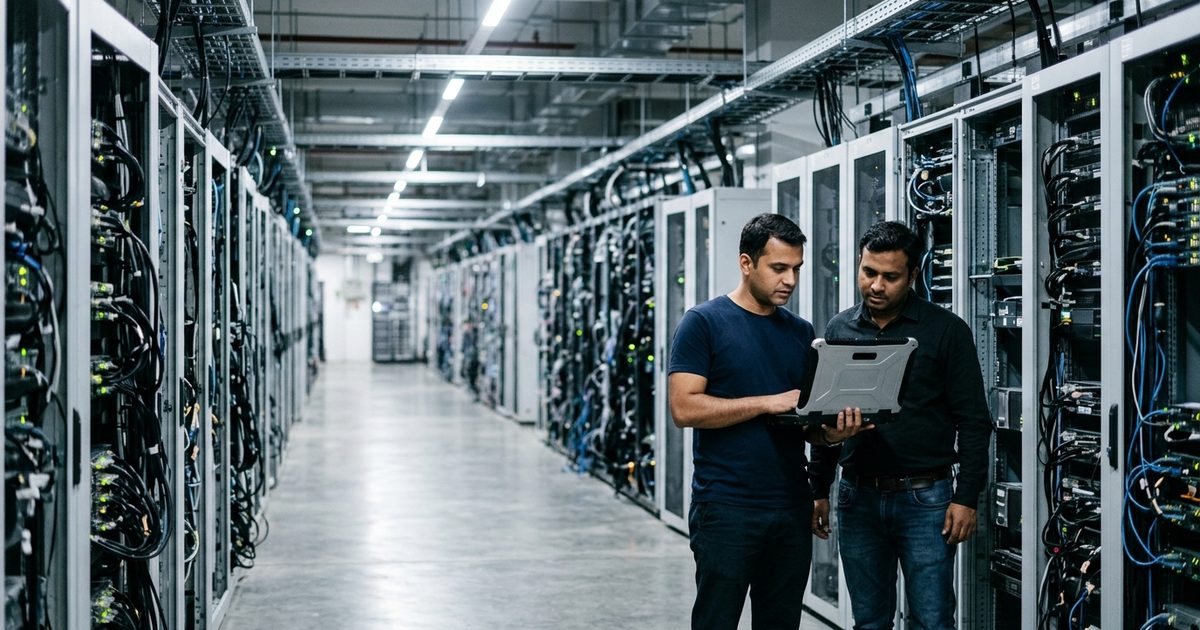
India has attracted over 300 billion dollars in data centre investment commitments within the past year, and operational capacity is projected to triple by 2030, possibly even grow six-fold. The demand side of the ledger is far less impressive. Subsidised graphics processing units supplied under the IndiaAI Mission are reportedly running at roughly 20 per cent utilisation, even though they are available well below market rates. Yotta, the country's largest GPU-as-a-service operator, is estimated to earn about 80 per cent of its revenue from foreign clients and has separately agreed to distribute capacity through Nvidia's global compute marketplace, DGX Cloud Lepton. Domestic enterprise AI workloads, meanwhile, continue to route through global cloud providers rather than Indian servers.
Put simply, the infrastructure is being built in India and filled largely by overseas demand. For an Indian student who needs GPU hours for a project, or a startup that wants to train a model without paying dollar rates, that gap is the practical story here. Capacity exists and is being sold cheaply, but the pipeline that connects it to local users is still thin.
03.The jobs promise does not add up
State governments justified their packages of land, power waivers and capital subsidies to data centre investors mainly on employment grounds, and the report documents the distance between those promises and what the facilities deliver. Andhra Pradesh's IT Minister cited two lakh jobs from a single project, while the state's own agency estimates around 200 direct operational positions. Construction employment peaks during the build and then disperses. Maharashtra has already revised its green energy incentive framework within five months of implementation, and Tamil Nadu and Karnataka have announced similar revisions.
That arithmetic matters for anyone planning a career around the boom. Data centres are capital-intensive installations, not large employers. The hiring that lasts is on the other side of the cable: people who can take an AI model and make it work inside a bank's loan system, a hospital's records or a manufacturer's supply chain.
04.Where India is actually winning
The report's most constructive section covers the services layer. Tata Consultancy Services and Infosys reported annualised AI services revenue of 7.5 per cent and 8 per cent of total revenue respectively in their most recent results, growing at double-digit rates, even as overall IT revenue growth hit a six-year low. The mechanism is the forward-deployed engineer, a software professional who sits inside the client organisation and customises an AI deployment to its specific systems, workflows and data. An entry-level forward-deployed engineer based in India costs under a tenth of the equivalent role in the United States.
There is a reason this work resists automation. A 2025 study from MIT found that 95 per cent of generative AI pilots at large organisations fail, not because the models underperform but because of lags in integration and gaps in knowledge. That knowledge is client-specific, tied to legacy systems, data architecture and everyday workflows, and it has to be learned on site. This is the work Indian IT firms are increasingly being paid for, and it explains why AI services revenue is growing while headcount growth has slowed.
05.What this means for Indian readers
For small businesses, the immediate effect is price. When hundreds of billions of dollars are committed to compute and only a fifth of the subsidised capacity is used, the pressure to fill racks pushes prices down. Indian firms can rent AI compute and tools today at rates that were unthinkable a few years ago, which is why a five-person business can now afford the same class of models a large enterprise used in 2023. The catch is that cheap compute only pays off when a business targets one specific, measurable problem rather than buying a platform and hoping.
On building India's own models, labs backed by the IndiaAI Mission have concentrated on large language models, with Sarvam AI's 105-billion-parameter model the most prominent result so far. The reasoning behind native Indic models is sound, since a model trained on Hindi, Tamil or Bengali handles those queries more efficiently than one translating on the fly. The report's scepticism is about market size rather than technical merit: the domestic market for Indic-specific AI products may not be large enough to fund frontier model development while better-capitalised foreign labs close the performance gap.
Frequently asked questions
What does the Rhodium Group report say about India's AI ambitions?
It argues that India's AI infrastructure build-out has run far ahead of domestic demand, with subsidised compute underused and jobs below what states were promised. It says India's genuine advantage lies in AI services work for global clients.
Are India's subsidised AI GPUs really sitting idle?
The report says GPUs supplied under the IndiaAI Mission are running at roughly 20 per cent utilisation despite being priced below market rates. India's largest GPU-as-a-service operator is estimated to earn about 80 per cent of revenue from foreign clients.
Should students avoid careers in AI infrastructure because of this?
Not avoid, but recalibrate. Data centres create relatively few permanent jobs per rupee invested, while demand is growing for people who can integrate AI into a client's existing systems, data and workflows.