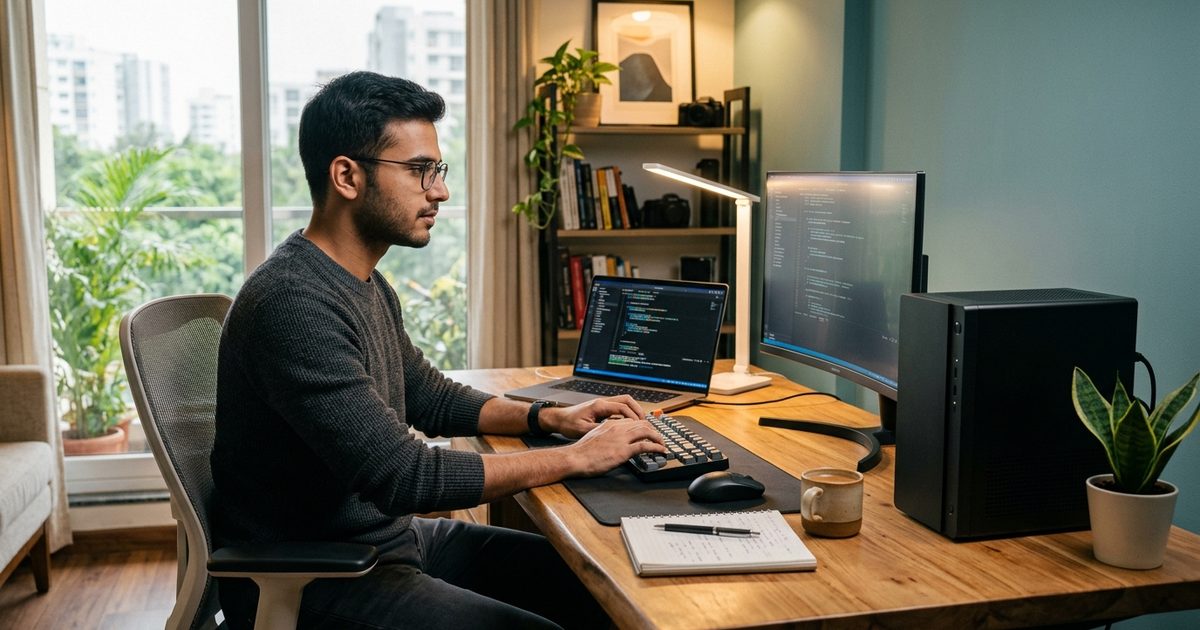
There's a quiet counter-trend building against the everything-in-the-cloud model of AI, and Nvidia is now openly championing it. In an interview published this weekend, Adel El Hallak, senior director of product management for Nvidia AI, made the case that local AI — models running on hardware you physically own — has arrived for real. "I could run a good enough model on my system at home," he told Tom's Guide. Your data never leaves your house. There's no monthly fee. For anyone tired of subscription fatigue, that's a strangely appealing pitch. Here's what's actually going on.
01.What "local AI" actually means
Local AI is exactly what it sounds like: instead of your prompts travelling to a data center and back, the model runs on your own machine — a desktop box, or soon, a laptop. No per-token billing, no usage caps, no internet connection required, and no company in the middle holding your documents. El Hallak's framing is that this is shifting from a developer hobby to something more like an appliance. The man running Nvidia's AI product strategy apparently keeps a personal AI computer at home himself, treating it "more like an appliance than a server." When the person selling the pickaxes uses them at the kitchen table, that tells you something.
02.DGX Spark: a Mac mini that thinks
The current flagship of this idea is the DGX Spark, which Nvidia launched last October as "the world's smallest AI supercomputer." It's roughly the size of a Mac mini, weighs about 2.6 pounds, runs Linux, and packs the GB10 Grace Blackwell superchip with up to a petaflop of AI performance and 128GB of unified memory — enough to run models with up to 200 billion parameters at your desk, per Nvidia's own specs. The price: $4,699 in the US, which works out to roughly ₹4 lakh in India after conversion. Not cheap. But that's where El Hallak's math gets interesting.
03.The subscription math nobody does
Here's the argument that made me sit up. A ChatGPT Plus subscription costs $20 a month — about $240 a year, or $1,200 over five years — and at the end of it you own nothing. The Spark, meanwhile, runs unlimited queries with no per-token billing and no usage caps. Five years of subscription versus one upfront purchase aren't perfectly comparable, and El Hallak admits it's not apples-to-apples: cloud frontier models are significantly more capable than the open-weight models you'd run locally. But for a growing set of everyday jobs — summarising documents, drafting emails, searching your own files, running a coding assistant — a local model is increasingly "good enough." And "good enough" with zero recurring cost is a dangerous phrase for subscription businesses.
04.RTX Spark laptops arrive this fall
The desktop is the proof of concept; the laptops are the real play. RTX Spark laptops — notebook machines built around the same GB10 silicon — are expected to ship this fall from Dell, HP, Lenovo, Asus, MSI and Acer, and Microsoft is reportedly building a Surface Laptop Ultra around the chip. These aren't AI-only machines; they run Windows 11, play games and handle regular laptop work. But with 128GB of unified memory, they can run large language models that would choke any current consumer GPU. Nvidia has been positioning this class of machine as the "personal AI computer" — PCs redesigned around agents rather than apps, with new security primitives and its OpenShell runtime to keep on-device agents under user control.
05.The software is getting human-friendly
Hardware alone never sold a category, and El Hallak knows it. The part of his interview I found most telling was about setup: "You're not doing installs via a command line or a pip install," he said — the harness providers building the software layer around local models are "bringing it back to a GUI," like installing any Windows app. That matters enormously for adoption in India, where the population of people willing to fight with a terminal is very different from the population who could benefit from private AI. The ecosystem is already forming — we wrote about Perplexity's Portable Computer earlier, which packages a local model, agent tools and a sandboxed runtime on exactly this class of hardware, asking permission before any single step goes to the cloud. Pair that with open-weight models like Tencent's freshly open-sourced Hy4, and the local stack starts looking genuinely usable rather than experimental.
06.Let's keep it honest
Now the reality check, because I'd rather you hear it from me than from a keynote. Local models in 2026 are not GPT-6-class models. If your work needs frontier reasoning, the cloud still wins outright. A ₹4 lakh desktop is out of reach for most Indian students and professionals, and laptop prices for RTX Spark machines are still unknown. El Hallak's own bet is the Jevons logic — that cheaper intelligence means more consumption, not less — which is a thesis, not a guarantee. Local AI will likely be the private, always-on layer of your setup, not the whole thing. Hybrid is the realistic future: local for routine and sensitive work, cloud for heavy lifting.
Related reads: if this story clicked for you, Microsoft Nvidia October 7 Event: Local AI PCs Explained and Huawei's AI Chip Push: Ascend 960DT Moved Up to Early 2027.
Key Takeaways
- Nvidia's AI product chief says local AI has arrived — models running on your own hardware, with no subscription and no data leaving home
- DGX Spark ($4,699, ~₹4 lakh) delivers 128GB unified memory and a petaflop of AI compute in a Mac mini-sized Linux desktop
- RTX Spark laptops with the same GB10 chip are expected this fall from Dell, HP, Lenovo, Asus, MSI, Acer and Microsoft Surface
- Setup is shifting from command-line installs to GUI-based app-like experiences — the key to mainstream adoption
- Frontier cloud models remain significantly more capable; the realistic near future is hybrid — local for routine and private work, cloud for heavy tasks
Frequently Asked Questions
What is the Nvidia DGX Spark?
The DGX Spark is Nvidia's Mac mini-sized desktop AI computer, launched last October as "the world's smallest AI supercomputer." It runs Linux, weighs about 2.6 pounds, and uses the GB10 Grace Blackwell superchip to deliver up to a petaflop of AI performance with 128GB of unified memory — enough to run models with up to 200 billion parameters locally.
How much does the DGX Spark cost in India?
The DGX Spark is priced at $4,699 in the US, which works out to roughly ₹4 lakh after conversion. There is no per-token billing or usage cap after the upfront purchase, unlike a monthly AI subscription.
When do RTX Spark laptops launch and who makes them?
RTX Spark laptops, built around the same GB10 silicon as the DGX Spark, are expected to ship this fall from Dell, HP, Lenovo, Asus, MSI and Acer. Microsoft is reportedly building a Surface Laptop Ultra around the chip as well. They run Windows 11 and work as regular laptops while also running large local models.
Is local AI as good as cloud AI models?
Not yet. Nvidia's own Adel El Hallak admits cloud frontier models are significantly more capable than the open-weight models you can run locally. The realistic near-term picture is hybrid: local AI for routine and private work like summarising documents, drafting emails or running a coding assistant, and cloud models for heavy tasks — with no subscription fee and no data leaving your machine on the local side.
What This Means for You
If you're an Indian professional handling sensitive material — client documents, medical records, financial data, legal drafts — local AI is the first version of this technology that takes your privacy concerns seriously instead of asking you to sign them away. For students, the smarter move today isn't rushing to buy hardware; it's learning to work skilfully with cloud models now (the free and low-cost tiers are generous), because the prompting and agent skills transfer directly to local models as they get cheaper. And when you do start paying for AI, spend deliberately — the GPT-6 Astra — Zero to Hero Guide includes a full cost-optimization chapter that shows you how to run a serious AI workflow without the runaway bills, which is exactly the discipline that will decide whether local AI saves you money or just becomes another expensive gadget on your desk.
And if GPT-6 Astra itself is still new to you, our GPT-6 Astra explainer is the best place to start — it covers what the model does, what it costs, and how to stay safe while using it.