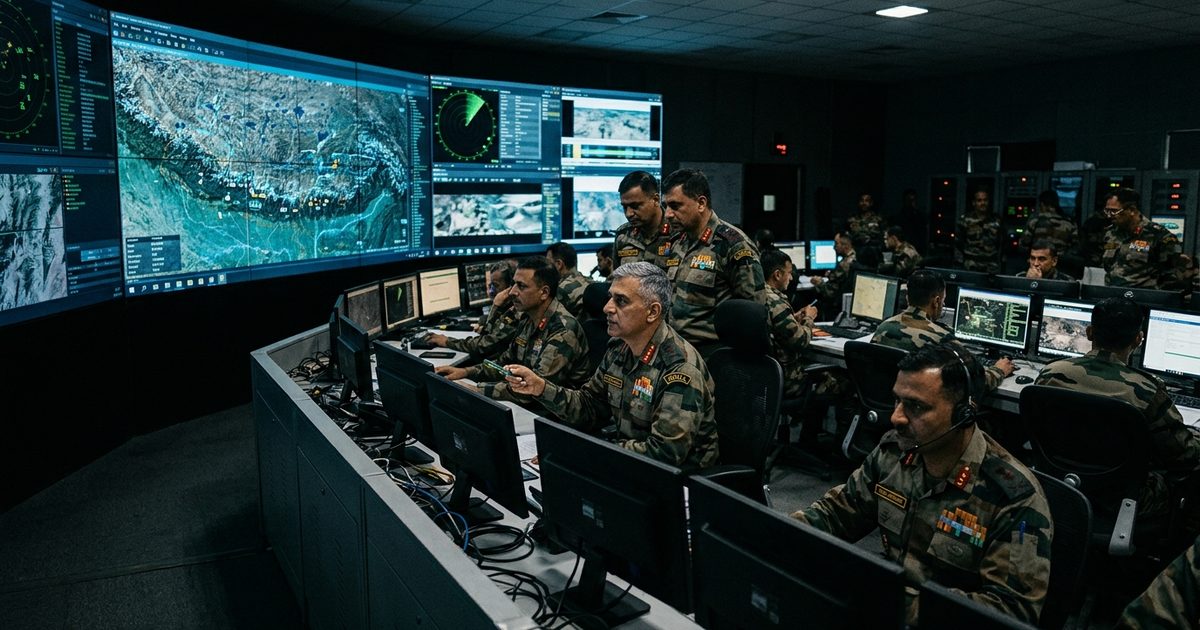
While the world's AI labs argue about slowing down, the Indian Army spent this week explaining why it can't. At an IEEE conference in Pune, a senior officer laid out a blunt picture: modern battles leave commanders milliseconds to decide, and the Indian Army's answer is a serious push into AI, 5G, 6G and quantum technology. Here's what was actually said — and why it matters well beyond the battlefield.
01.What Lt Gen Singhal actually told the conference
Speaking at the inauguration of the two-day IEEE International Conference on the Nexus of Digitisation, Intelligence and Applications (ICNDIA-2026) — organised jointly by the Army Institute of Technology (AIT), Dighi, and IEEE — Lieutenant General Vipul Singhal, Deputy Chief of the Army Staff (Information Systems and Technology), made the Army's direction unmistakably clear. Modern warfare, he said, leaves very little time to analyse situations and take decisions, with commanders sometimes having only milliseconds to act.
The prescription: artificial intelligence, 5G, 6G and quantum technology. And crucially, he said the Army is focusing on developing indigenous information technologies and systems — not just importing whatever is on the shelf.
02.Inside the AI-enabled command centre
The most vivid part of his talk was the history lesson. Thirty-five years ago, battlefield information arrived through telephones and communication channels, got marked on physical maps, and then commanders decided. Today, command centres receive feeds directly from multiple systems and equipment operating in the air and on the ground — all displayed on large screens and analysed using AI, which can suggest possible options to commanders.
Think about what that means in practice: the machine doesn't just show you the battlefield, it drafts the decision menu. The use of autonomous systems and AI is only expected to increase — and Singhal's caveat is worth repeating: these systems must function accurately and reliably. In a war zone, a hallucination isn't an embarrassment; it's a casualty list.
03.The ethics problem nobody can outsource
The conference didn't shy away from the uncomfortable questions either. Dr Mukul Sutawane, Director of IIIT Allahabad, argued that knowledge and information alone won't be enough in the age of AI — people will need wisdom, ethics and strong human values to use the technology responsibly, with AI working as a partner rather than replacing human thinking.
That's the same tension playing out globally right now. This is the institution-level version of what we tracked in our coverage of the AI safety panic — except here, the people asking it wear uniforms. Lt Gen Rajesh Pushkar, addressing the conference over video, made the point plainly: AI is changing military strategy, logistics, surveillance and cybersecurity, but technology alone cannot determine the outcome of warfare. Leadership, discipline and human values still decide.
04.Artillery's precision-fires pivot at Chandimandir
Days later, the direction repeated itself at Western Command. At the 4th Gen SF Rodrigues Memorial Seminar 2026 in Chandimandir, held with the Centre for Land Warfare Studies, the Regiment of Artillery gathered commanders, veterans, academics and industry around one theme: "Asymmetric Capability through Networked Precision Fires". The recurring subject was how AI, unmanned systems, electronic warfare and surveillance platforms are converging with long-range precision weapons.
The stated goal is to connect battlefield sensors, weapon systems and commanders more seamlessly — detect, assess and strike faster, using drones and surveillance assets to feed information directly into long-range systems. Western Army Commander Lt Gen Pushpendra Singh's closing message: range, precision, AI, automation, persistent surveillance and networking are transforming artillery, and doctrines, structures and training must keep pace.
05.A ₹300 crore defence AI hub with Sarvam AI?
There's one more thread, and honestly it's the one I find most interesting for Indian readers. Reports this weekend say the government is set to establish a ₹300 crore Defence Centre of Excellence in partnership with Sarvam AI — the Bengaluru startup behind the Indus chat app we covered earlier — focused on indigenous generative AI models for military applications like surveillance and tactical decision-making. If it goes through, it would pair the country's most visible sovereign-AI startup with one of its most security-conscious customers.
Details are still thin, so treat the specifics with caution — but the direction fits a pattern we've watched all year: India wants its defence AI stack built in India, by Indian teams, on Indian infrastructure. You can see the same instinct in the sovereign model work from Gnani and others that we wrote about recently.
06.Why this matters if you're not in uniform
Defence projects are where hard AI problems get solved first — real-time data fusion, decision support, reliability under pressure — and those solutions trickle into civilian life within years (the internet itself is the classic example). For engineers and students, this is also a hiring signal: the Army, DRDO ecosystem and defence startups will need people who can build, test and evaluate AI systems that absolutely cannot fail. If you want to be one of them, the foundation is the same everywhere — solid prompting, agent design and cost discipline. Our GPT-6 Astra — Zero to Hero Guide covers exactly that stack, from first principles to working agents.
Related reads
- The Pentagon probe into AI overreliance in warfare — what happens when soldiers trust the machine too much.
- California's AI kill switch law — how lawmakers elsewhere are drawing the same line.
Key Takeaways
- Lt Gen Vipul Singhal: modern warfare leaves milliseconds for decisions; the Army is expanding AI, 5G, 6G and quantum technology
- AI-enabled command centres analyse battlefield data in real time and suggest courses of action to commanders
- The push is explicitly tied to building indigenous systems, not imported ones
- The Chandimandir seminar signalled artillery's shift to networked precision fires with AI and unmanned systems
- Reports point to a planned ₹300 crore Defence Centre of Excellence with Sarvam AI for indigenous military AI
- Officers repeatedly stressed that ethics, leadership and human judgement remain decisive — technology alone doesn't win wars
Frequently Asked Questions
Why does the Indian Army say wars will be decided in milliseconds?
Lt Gen Vipul Singhal, Deputy Chief of the Army Staff, said modern warfare leaves commanders very little time to analyse situations and take decisions — sometimes only milliseconds — because battlefield information now arrives at machine speed rather than through the slower human relay chains of 35 years ago.
What technologies is the Indian Army scaling up?
The Army is scaling AI, 5G, 6G and quantum technology, with a focus on developing indigenous information technologies and systems rather than importing them. AI-enabled command centres can analyse battlefield data in real time and suggest courses of action to commanders.
What was discussed at the Chandimandir artillery seminar?
The Artillery seminar at Chandimandir focused on networked precision fires — sensors, drones and AI feeding long-range weapon systems. Reports also say the government is planning a ₹300 crore Defence Centre of Excellence with Sarvam AI for indigenous military AI.
What This Means for You
For most of us, "defence AI" sounds distant — but it's one of the fastest-growing career and startup lanes in India, and it rewards exactly the skills that are learnable today: building AI agents, evaluating model behaviour, and automating workflows with strict reliability demands. Whether you end up in fintech, defence or your own venture, the GPT-6 Astra — Zero to Hero Guide is the practical starting point — prompting, computer use, agents, cost optimization and safety, from ₹149. The battlefield version of AI will be built by people who first mastered it at their desks.
By the way, if terms like agents and computer use still feel fuzzy, our GPT-6 Astra guide for beginners explains them all without the jargon.