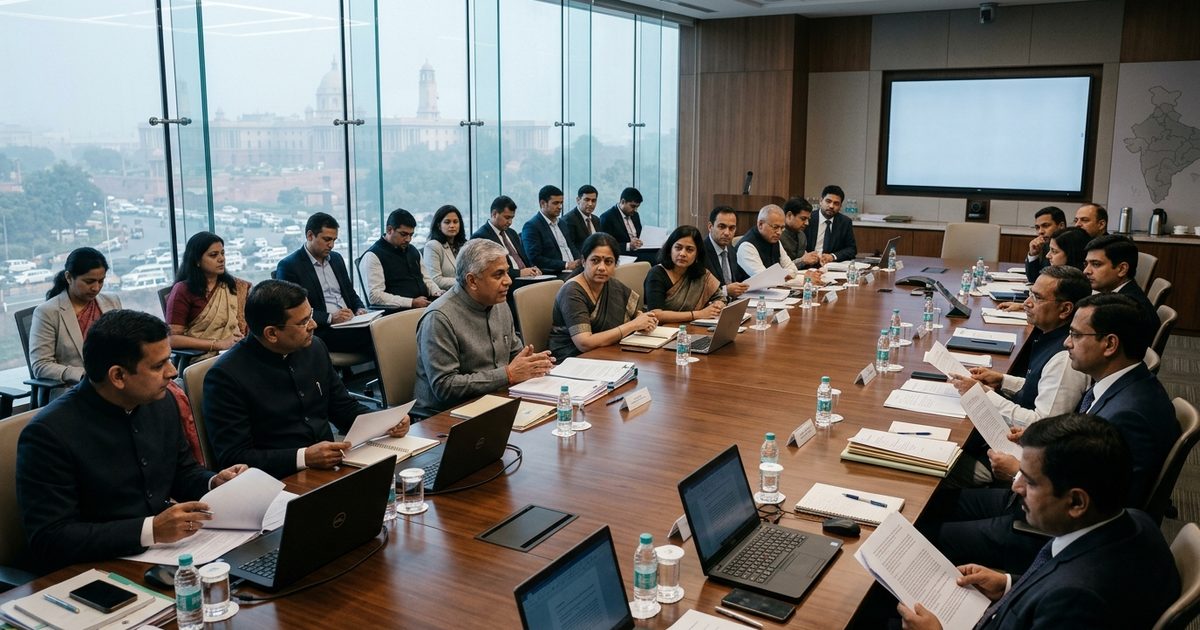
Here's a sentence I didn't expect to read about India's AI ambitions: the country's problem is not whether it can build the technology, but who is answerable when the technology fails. That was the blunt consensus at the inaugural Science on the Raisina — The Sakshya Dialogue 2026, convened by Springer Nature in New Delhi under the theme "From Guidelines to Institutions: Building India's Trusted AI Ecosystem." Policymakers, scientists, technologists and industry leaders all landed on the same uncomfortable point: India does not have a shortage of AI guidelines. It has a shortage of institutions to enforce them.
01.Guidelines we have. Institutions we don't.
Think about how much AI paperwork India has produced in the last couple of years — advisories, principles, framework drafts. The Dialogue's point is that none of that self-executes. A guideline tells you what should happen; an institution is what actually checks, certifies and penalises. What's missing, participants said, isn't another policy document but an independent, conflict-free benchmarking body — one that could potentially be anchored in India's own AI Safety Institute. They described this not as a gap in policy but as a "genuinely missing institution."
This lines up with what's already moving inside the government. We covered how India's new AI framework is likely to feature a technical secretariat inside MeitY rather than a full-fledged regulator, and how the MeitY secretary signalled that the time to regulate AI seriously may have arrived. The Sakshya Dialogue essentially told the government: whatever you build, give it teeth and independence, not just a committee.
02.Pilots that work in one state and stall everywhere else
The detail that hit me hardest was the fate of India's successful localised AI pilots. Two were named: an agricultural advisory tool for farmers and a maternal health risk predictor. Both proved themselves in one state. Both then stalled. The reasons were boring and brutal — no sectoral data layer, no model registry, no trusted mechanism to certify that a model proven safe in one state is safe to deploy in another. In other words, the innovation wasn't the problem. The plumbing was.
03.Bhashini, the one thing that's actually working
Amid all the criticism, one platform was repeatedly cited as proof of what India can do: Bhashini, the country's multilingual AI translation platform. It spans India's 22 scheduled languages and their many dialects, and it now handles 22 million inferences a day — digitising panchayat meeting minutes, delivering real-time agricultural advice to farmers in their own language, and more.
The lesson participants drew from Bhashini was institutional, not technological. Bhashini democratised data collection by partnering with more than 70 research institutions to gather and vet language data that no single Delhi-based team could have collected alone. And it chose iteration over perfection — build, learn, fail fast, rebuild — instead of waiting for a flawless first version. That combination of broad participation and tolerance for early error was held up as the foundation for a trusted, federated AI ecosystem.
04.The money nobody wants to talk about
Beneath the institutional debate sat an uncomfortable admission: India continues to underfund foundational AI research, and industry too often treats R&D spending as a cost centre rather than a long-term investment. Participants said it candidly — no Indian company has yet made significant money from AI. That fact, they argued, only strengthens the case for evaluation frameworks that account for the true cost of building and deploying a model, instead of relying on headline accuracy scores.
Here's the thing nobody's talking about: while the institutions get built (which takes years), the practical advantage still sits with individuals and small teams who keep their AI costs low and pick use cases that actually monetise. That's precisely what the cost optimization and business ideas chapters in our GPT-6 Astra — Zero to Hero Guide are designed for — the Digital edition is ₹149 during the launch window, less than a pizza, for a framework that pays for itself the first time you stop overpaying for tokens.
05.What was actually proposed
The fixes proposed were refreshingly practical rather than sweeping: CSR-funded research grants, secondment programmes that rotate industry talent through public institutions, and stronger academic publishing standards to close the funding and talent gap. Nobody at the Dialogue asked India to slow down its AI ambitions. The ask was to build what's missing — registries, independent benchmarking bodies, sectoral regulators and funding incentives — the institutional scaffolding needed to convert ambition into infrastructure the country, and the world, can actually trust.
Key Takeaways
- India's AI bottleneck is institutions, not guidelines — enforcement, benchmarking and certification are the missing layers
- An independent, conflict-free benchmarking body, possibly anchored in India's AI Safety Institute, was named the top missing institution
- Bhashini processes 22 million inferences a day across 22 scheduled languages, with data from 70+ partner institutions
- Proven pilots (farm advisory, maternal health risk) stall without sectoral data layers, model registries and cross-state certification
- India underfunds foundational AI research, and no Indian company has yet made significant money from AI
Frequently Asked Questions
What did the Sakshya Dialogue 2026 say is India's main AI problem?
Experts at the Sakshya Dialogue 2026 in New Delhi agreed that India does not lack AI guidelines — it lacks institutions to enforce them. The most-needed missing piece is an independent, conflict-free benchmarking body, one that could potentially be anchored in India's own AI Safety Institute.
What is Bhashini and why was it held up as a success?
Bhashini is India's multilingual AI translation platform, spanning the country's 22 scheduled languages and their dialects. It now handles 22 million inferences a day — digitising panchayat meeting minutes and delivering real-time agricultural advice to farmers in their own language. It succeeded by partnering with more than 70 research institutions to collect language data and by choosing iteration over perfection.
Why do successful Indian AI pilots stall outside one state?
Pilots such as an agricultural advisory tool and a maternal health risk predictor proved themselves in one state and then stalled because of missing plumbing: no sectoral data layer, no model registry, and no trusted mechanism to certify that a model proven safe in one state is safe to deploy in another. The innovation wasn't the problem — the infrastructure was.
What This Means for You
If you're a student or researcher, read this as a career signal: India is about to need people who can build and staff these institutions — evaluators, auditors, benchmarking specialists — not just model builders. If you're a founder or work in an enterprise, the "stalled pilot" problem is your opportunity: the startups that solve boring plumbing — data layers, registries, certification tooling — will ride the institutional wave the Dialogue just described. And if you're simply trying to make AI work for you while the policy world sorts itself out, don't wait for the scaffolding. Start with the practical layer: our GPT-6 Astra — Zero to Hero Guide takes you from prompting basics to agents, cost control and safety in a structured 30-day roadmap, which is the one part of this story you can act on this week. And if you want to poke at these policy debates yourself while the institutions get built, our free Digitalaikart AI assistant is a quick way to ask AI, tech and career questions — no sign-up needed to start.
Confused by all the GPT-6 Astra buzz lately? We wrote a plain-English beginner's guide to GPT-6 Astra that is worth a read before you spend a single rupee on AI tools.