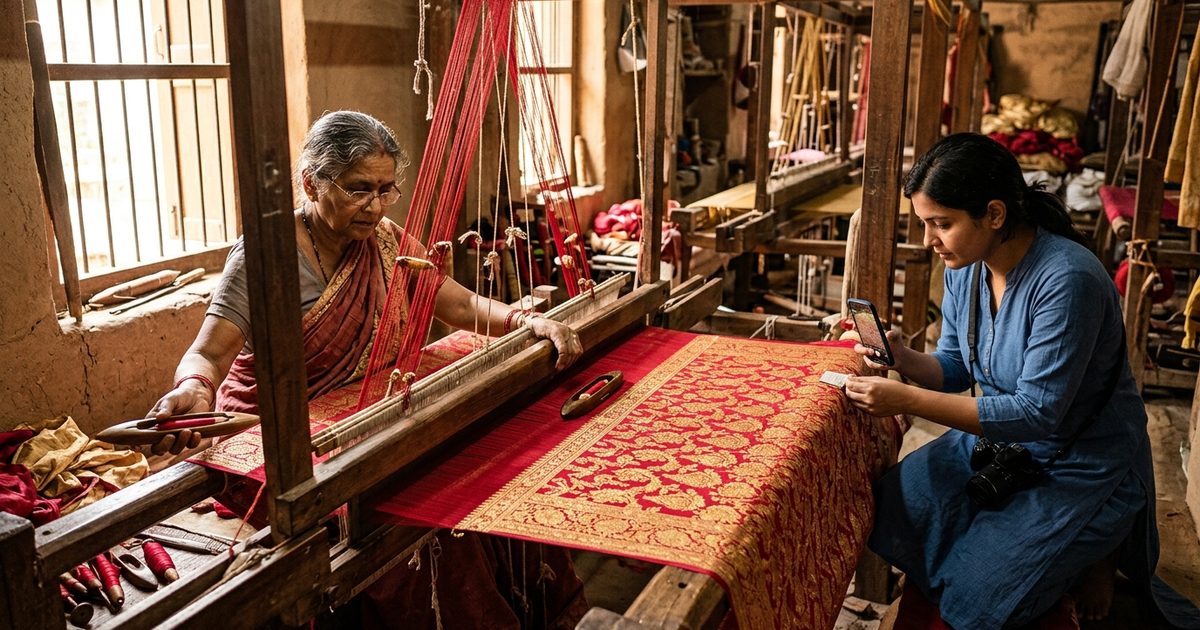
From the looms of Banaras to the digital marketplace — that's the journey IIT Madras wants to make possible. The institute has launched an Artisan Empowerment Lab in partnership with Varanasi-based non-profit Human Welfare Association (HWA), using AI and blockchain to give the city's legendary crafts a technological upgrade. And no, this isn't another "AI chatbot" story — this is AI doing something quietly useful for people whose skills have been undervalued for decades.
01.What the Artisan Empowerment Lab actually does
The core idea is a trusted digital registry of artisans and their products. Every registered artisan gets a documented digital identity; every authentic product gets linked to its actual maker. AI helps document and organise this at scale, while blockchain makes the records tamper-proof — so a "genuine Banarasi saree" claim can actually be checked instead of just trusted.
The lab is designed to act as a bridge between traditional craftsmanship and modern digital systems — improving product authenticity, increasing visibility for craftspeople, and helping artisans connect more directly with buyers. The team behind it, led by Professors John Augustine and Manivannan Muniyandi, also plans to harness AR, VR and computer vision technologies to empower the artisans.
02.Scan a QR code, meet the weaver who made your saree
Here's the feature I find genuinely exciting. Authentic GI (Geographical Indication) tagged products sold in the market will carry QR codes. Scan one, and you can verify the product is genuine — plus see details about the artisan who actually made it. Imagine gifting a Banarasi saree and being able to show the recipient the name and story of the weaver behind it. That's not just authentication; that's connection.
The pilot starts with five GI-tagged craft categories from the Varanasi region: Banaras Brocade and Sarees, Varanasi Soft Stone Jali work, Banaras Gulabi Meenakari, Varanasi Wooden Lacquerware and Toys, and Banaras Metal Repousse Craft. The lab will work directly with around 500 artisans in the coming months.
03.Who's behind it — the "GI Man of India"
The MoU was signed on August 25 by Dr Rajani Kant, the Padma Shri awardee known as the "GI Man of India", on behalf of HWA, along with Prof Manu Santhanam, Dean of Industrial Consultancy and Sponsored Research at IIT Madras, in the presence of institute director Prof Veezhinathan Kamakoti. HWA describes it as India's first MoU of its kind focused on post-GI technological support — getting a GI tag is one thing, but what happens after has mostly been ignored.
Prof Kamakoti's framing is worth noting: the lab should help artisans increase their income while preserving India's heritage, and a technology-led model could reduce the role of middlemen in the craft supply chain — letting artisans reach customers directly and receive fair value for their skills.
04.Why this matters more than it sounds
Here's the thing nobody's talking about: Indian handicrafts have a counterfeiting problem that quietly bleeds the people at the bottom. Powerloom fakes sold as "handwoven Banarasi" undercut real weavers, and the weaver gets nothing from the premium a genuine piece deserves. An AI-verified, blockchain-backed registry attacks that problem at the root — the same way UPI attacked trust in payments.
Dr Rajani Kant says the project will begin from Varanasi — one of the world's oldest living cities and an emerging hub of GI products — and support the Atmanirbhar Bharat and "Local to Global" campaigns. His long view: "Millions of artisans, weavers, farmers and women will benefit in the long run after this project is expanded at the national level."
05.The bigger picture: AI for Bharat's real economy
We write a lot here about frontier models and billion-dollar labs, but some of the most meaningful AI work in India is happening at the intersection of technology and livelihoods — and IIT Madras keeps showing up in that story. We covered the institute's AI studio launch earlier, and this lab is a different flavour of the same instinct: apply serious engineering to problems that actually change incomes. It's also a cousin of the heritage-meets-AI work we saw with the Sanskrit AI model — technology reaching backwards into tradition instead of only forwards.
For small businesses watching this space, the playbook is instructive: verification, provenance and trust are becoming product features. If you're thinking about how AI could power your own venture — whether it's a craft marketplace or something completely different — our GPT-6 Astra — Zero to Hero Guide walks through building AI agents and practical business ideas step by step, including how to keep costs sane while you experiment.
Key Takeaways
- IIT Madras and HWA Varanasi have launched an Artisan Empowerment Lab — a trusted digital registry for GI crafts using AI, QR codes and blockchain
- Buyers will be able to scan a QR code to verify a product is genuine and see the artisan behind it
- The pilot covers five craft categories and about 500 artisans, including brocade sarees, Gulabi Meenakari and wooden toys
- The MoU was signed on August 25 by Padma Shri awardee Dr Rajani Kant, the "GI Man of India"
- Long-term goals: cutting middlemen, fairer prices for artisans, and a national-level centre for the GI ecosystem
Frequently Asked Questions
What is the IIT Madras Artisan Empowerment Lab?
It is a new lab launched by IIT Madras in partnership with Varanasi-based non-profit Human Welfare Association (HWA) to digitise Varanasi's famous GI-tagged crafts. It builds a trusted digital registry of artisans and their products, using AI to document and organise records at scale and blockchain to make them tamper-proof.
How will QR codes help buyers verify Banarasi crafts?
Authentic GI-tagged products will carry QR codes that buyers can scan to verify the item's authenticity and see the actual artisan who made it. The pilot starts with about 500 artisans across five craft categories, including Banarasi brocade sarees and Gulabi Meenakari.
Who is leading the artisan lab and what technologies are involved?
The lab is led by Professors John Augustine and Manivannan Muniyandi of IIT Madras. Beyond the AI-and-blockchain registry, the team also plans to use AR, VR and computer vision technologies to empower artisans and connect them more directly with buyers.
What This Means for You
If you're from a craft family or work with artisans — even informally — this project is worth following closely, because a verified digital identity could change what your work sells for. If you're a student or entrepreneur, take this as a signal: the next wave of Indian AI opportunities won't only be in chatbots and coding. They'll be in applying AI to verify, document and market the things India has always been good at making. And if you want to be the one building those solutions, start with the GPT-6 Astra — Zero to Hero Guide — it takes you from your first prompt to working AI agents for ₹149, with a printed edition available too.
One more thing — if you are still getting up to speed on GPT-6 Astra itself, our complete GPT-6 Astra walkthrough explains the model, the pricing and the privacy basics in one sitting.